
By Dr. Rich Prather, D.C. · Educational information, not individualized medical advice.
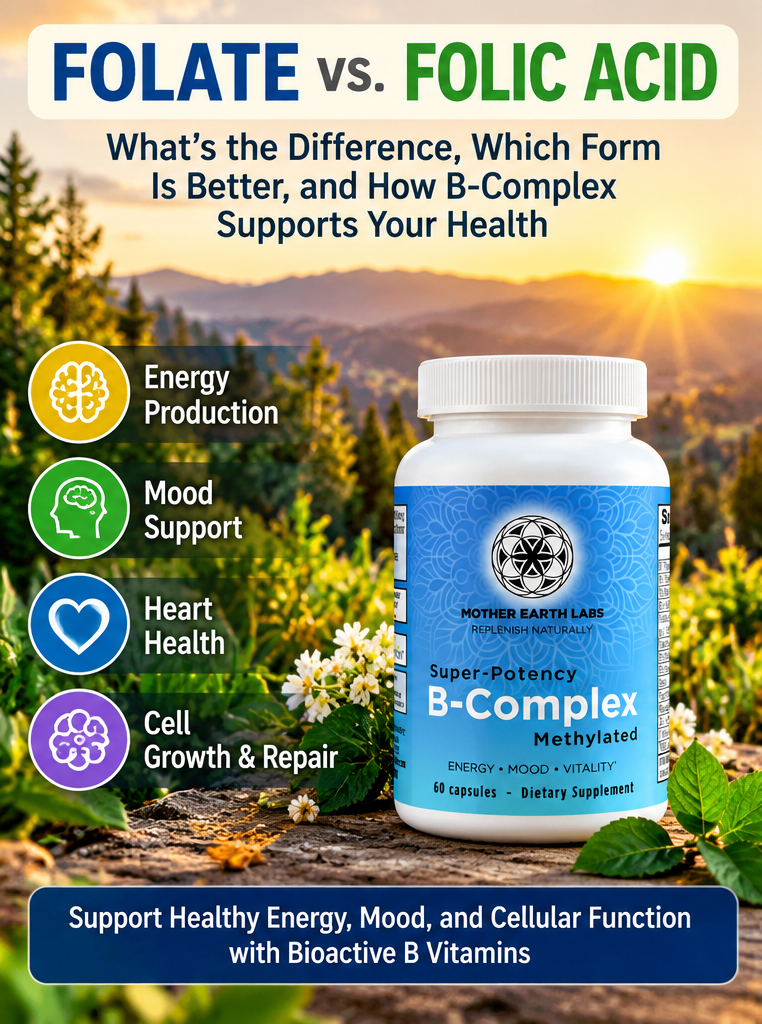
Direct answer: Folate is vitamin B9, a family of related compounds. Folic acid is a specific, stable form commonly added to fortified foods and supplements. They support the same essential nutrient requirement, but are not chemically identical. A supplement may instead use 5-MTHF, often labeled methylfolate. These forms should not be treated as interchangeable for every purpose, particularly pregnancy planning. The label’s mcg DFE figure helps account for differences in bioavailability.
Three terms that should not be confused
Food folate occurs naturally in leafy greens, legumes, asparagus and other foods. Folic acid is used in many enriched grain foods and supplements. 5-MTHF is another supplemental form, often called methylfolate. The presence of the word methylated does not automatically prove that a product is better for everyone.
How to read mcg DFE
A Supplement Facts label may say Folate 680 mcg DFE (400 mcg folic acid). This does not mean the bottle contains 680 mcg of folic acid. It reports 400 mcg folic acid, with a dietary-folate-equivalent amount that reflects its greater bioavailability when consumed with food. Under the NIH’s general conversion, 1 mcg DFE equals 1 mcg naturally occurring food folate or 0.6 mcg folic acid consumed with food. The calculation differs for folic acid taken on an empty stomach.
For adults, the RDA is generally 400 mcg DFE daily; requirements differ during pregnancy and breastfeeding. Check the full ingredient and serving panel rather than comparing a DFE number on one bottle with a raw folic-acid number on another.
Is methylfolate better than folic acid?
Some products use 5-MTHF. Research indicates it is bioavailable, but broad claims that everyone needs methylfolate or that folic acid is inherently harmful are not supported. Common MTHFR gene variants do not by themselves justify avoiding folic acid. The best choice depends on individual circumstances, medical history, and clinician guidance.
Pregnancy: a crucial distinction
For people who could become pregnant, U.S. public-health guidance specifically recommends 400 mcg folic acid daily from supplements, fortified foods, or both, in addition to food folate, to help prevent neural-tube defects. Do not replace this established recommendation with an unverified claim that methylfolate alone has identical prevention evidence. Anyone planning pregnancy or with a prior neural-tube-defect-affected pregnancy should obtain individualized clinical advice.
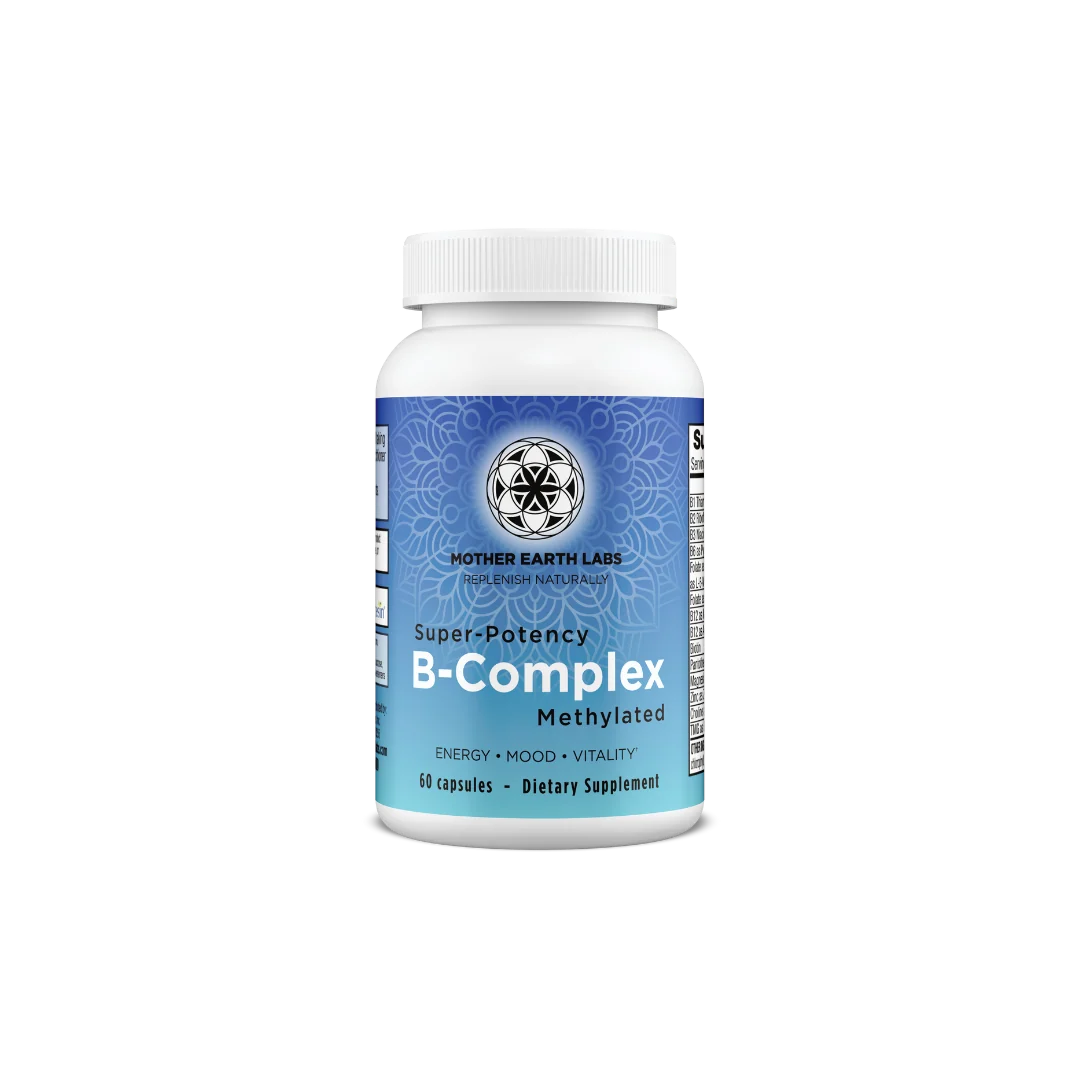
Original manufacturer bottle photograph supplied for this article.
Official Mother Earth Labs B-Complex label and Supplement Facts
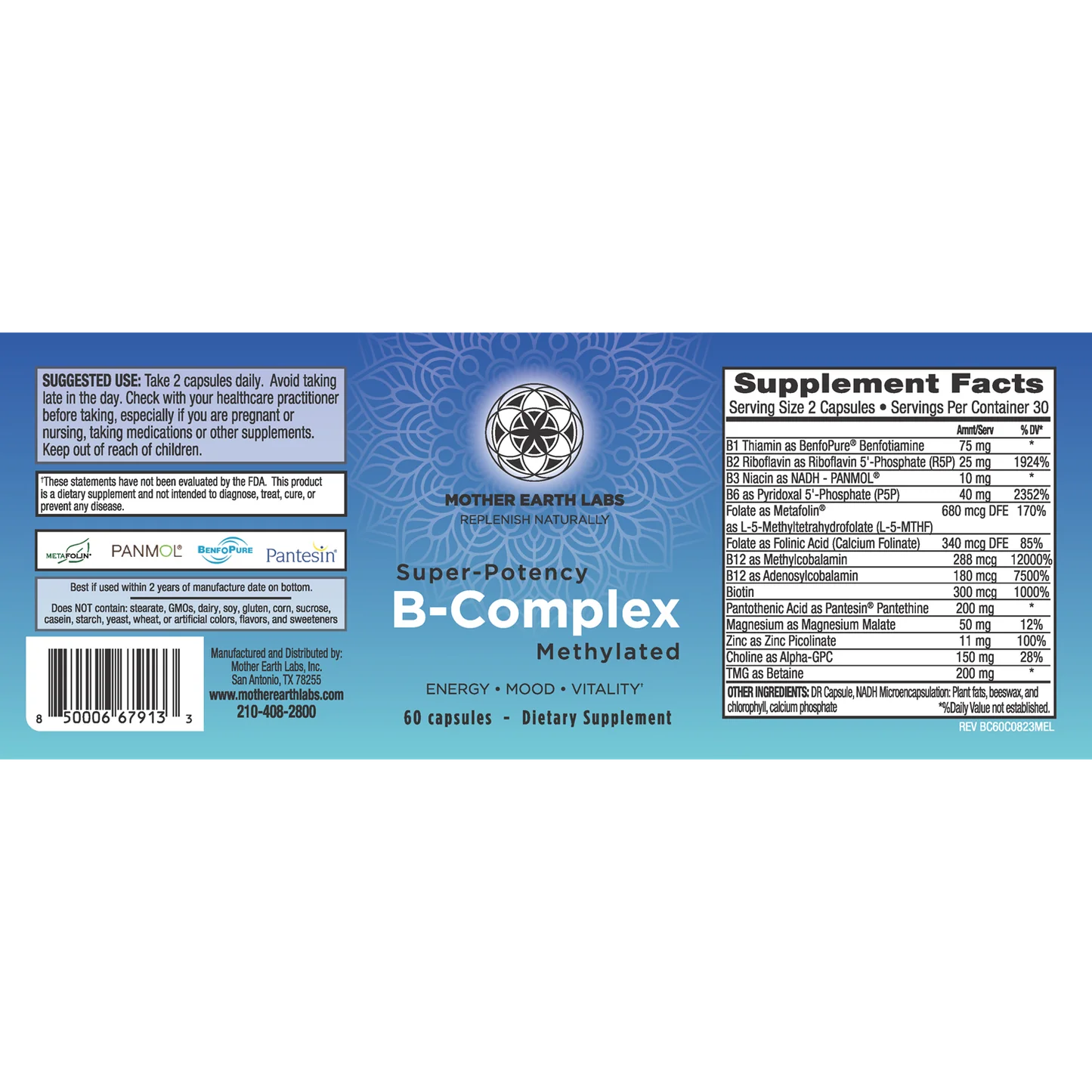
Original manufacturer label supplied for this article. Read the full-size image for the complete ingredient list and cautions; check the label on the bottle you receive for formulation updates.
What the supplied label actually says (per 2 capsules): Folate as Metafolin® L-5-methyltetrahydrofolate (L-5-MTHF), 680 mcg DFE (170% DV); folate as folinic acid (calcium folinate), 340 mcg DFE (85% DV). Together these lines total 1,020 mcg DFE per serving. It also lists vitamin B12 as methylcobalamin (288 mcg) and adenosylcobalamin (180 mcg), plus other B vitamins and nutrients. These two folate entries are distinct forms, not folic acid. Do not treat their combined DFE as evidence that the product fulfills the CDC’s separate 400 mcg folic acid recommendation for neural-tube-defect prevention.
Label directions: Take 2 capsules daily; avoid taking late in the day. Follow the package’s precautions, especially when pregnant, nursing or taking medication.
Product example: Mother Earth Labs Super-Potency B-Complex Methylated
The supplied Mother Earth Labs Super-Potency B-Complex Methylated label lists L-5-MTHF and folinic acid alongside other B vitamins. It is a product example, not evidence that methylfolate is superior for everyone or a substitute for established folic-acid recommendations for pregnancy.
View B-Complex at Mother Earth Labs ↗
The purchase button opens the named product at Mother Earth Labs. Confirm the exact formula, serving size, availability, and checkout price there before ordering.
Can you take too much?
High supplemental intake may be inappropriate. The adult tolerable upper intake level for folic acid from supplements and fortified foods is 1,000 mcg/day unless a clinician directs otherwise; naturally occurring food folate is treated differently. Large folate doses can complicate recognition of vitamin B12 deficiency. Review overlapping multivitamin, prenatal, B-complex, and fortified-food sources.
Five label checks before buying
- Find Folate in Supplement Facts and note mcg DFE per serving.
- Read the parentheses to identify folic acid, if listed.
- Look for 5-MTHF/methylfolate in the ingredient form.
- Check the serving size and how many products you already use.
- For pregnancy planning, prioritize evidence-based folic acid guidance rather than marketing claims.
Food folate, folic acid and methylfolate: what the body does with each
Natural food folates occur in several chemical forms and can be affected by cooking and storage. Folic acid is more stable, making it useful for fortifying grain foods and providing a consistent supplemental dose. The body processes folic acid through metabolic steps, while 5-MTHF is a reduced folate form used in some supplements. The fact that these pathways differ does not prove that one product is superior for every person.
Folate participates in DNA synthesis and normal cell division. Deficiency can cause megaloblastic anemia; however, fatigue or a laboratory abnormality does not by itself identify folate as the cause. Vitamin B12 deficiency, iron status, medications, dietary intake, and clinical history may matter. People with neurological symptoms should not self-treat with high-dose folate while delaying assessment.
Two labels that look similar but answer different questions
Example A: Folate 680 mcg DFE (400 mcg folic acid). This clearly identifies the folic-acid amount, while the DFE is an equivalence measure. Example B: Folate 680 mcg DFE (as L-5-methyltetrahydrofolate). This identifies a different supplemental form. The two products cannot be treated as identical for every clinical purpose simply because the DFE line matches. These are illustrative label formats; actual labels should be checked individually.
For someone capable of becoming pregnant, the CDC’s recommendation is specifically 400 mcg folic acid daily. A prenatal product containing only methylfolate does not automatically satisfy the wording or outcome-evidence basis of that recommendation. Those with a history of neural-tube-defect-affected pregnancy may need a different clinician-directed plan.
Common purchasing questions, answered directly
Is folic acid dangerous because it is synthetic? Manufacturing origin alone does not establish harm. Assess dose, indication, evidence, and total intake instead. Does an MTHFR result mean folic acid cannot work? No. CDC guidance says common MTHFR variants are not a reason to avoid folic acid. Should everyone take more than the daily value? No. Higher numbers are not automatically better and may complicate evaluation of other deficiencies. Do vegetables still matter if I take a supplement? Yes. A balanced diet contributes many nutrients and does not become optional because a capsule contains vitamin B9.
When to ask a clinician or pharmacist
Seek individualized advice if you are planning pregnancy, have a prior affected pregnancy, have unexplained anemia or neurological symptoms, have malabsorption, or use medicines that interact with folate metabolism. Review prescription medicines before adding supplements; for example, antifolate therapies require specialized management rather than generic advice from a supplement comparison page.
Which folate form should I choose? A decision guide
| Situation | What matters most |
|---|---|
| Trying to conceive or could become pregnant | Verify the label supplies 400 mcg folic acid daily, consistent with CDC guidance; do not assume methylfolate alone has equivalent neural-tube-defect prevention evidence. |
| General dietary comparison | Compare mcg DFE, serving size, and total intake from food, fortified foods, and supplements. |
| Product marketed for an MTHFR variant | Common MTHFR variants do not establish a need to avoid folic acid. |
| Multiple supplements | Add folic acid from fortified foods and supplements; consider the adult 1,000 mcg upper limit unless supervised. |
| Unexplained anemia or neurologic symptoms | Seek evaluation rather than treating with high-dose folate alone; vitamin B12 status may matter. |
Important qualification: The CDC states that folic acid at recommended amounts has not been shown to delay detection of vitamin B12 deficiency. The concern about high folate intake and B12 deficiency should not be presented as a reason to avoid recommended folic acid doses.
Important follow-up questions
Is 5-MTHF the same as folic acid? No. Both can contribute folate activity, but they are different compounds, and the evidence base for preventing neural-tube defects specifically supports folic acid.
Can I rely on leafy greens instead of folic acid before pregnancy? Folate-rich foods are valuable, but the CDC recommends a dependable daily 400 mcg of folic acid from fortified foods and/or supplements for people capable of pregnancy.
Is a higher %DV necessarily better? No. %DV is not a personal prescription, and a higher DFE figure does not automatically mean greater benefit.
What if my label lists folate but does not name the form?
The amount shown as mcg DFE is not, by itself, enough to identify the ingredient. Read the parenthetical form next to the nutrient and the full ingredient list. If the form is still unclear, request the current Supplement Facts panel from the manufacturer rather than assuming it is folic acid or methylfolate. For pregnancy planning, confirm that the product supplies the recommended amount of folic acid, not just a numerically similar DFE value.
Frequently asked questions
Are folate and folic acid the same vitamin?
They both supply vitamin B9 activity, but folic acid is one specific form, while folate is the broader term.
Is folic acid synthetic?
It is manufactured for fortification and supplements; this alone does not establish that it is unsafe.
Is methylfolate necessary with an MTHFR variant?
Not routinely on the basis of a common variant alone. Discuss specific concerns with a qualified clinician.
Does folate help with fatigue?
Deficiency can contribute to anemia and fatigue, but unexplained fatigue has many causes. Taking extra folate without assessing B12 and other potential causes is not a reliable shortcut.
Related reading
Use the Core & Balancer ingredient dictionary to check ingredient terminology, and the Supplement Facts guide for label-reading context.
Before you compare two products
Photograph or save the complete Supplement Facts panels, including serving size and the parenthetical folate form. Compare mcg DFE per serving, the actual amount of folic acid when relevant, and the number of servings you intend to take. A product with a larger DFE number is not necessarily more appropriate.
What this B-Complex label does—and does not—show
Do not confuse an ingredient’s DFE value with the amount of folic acid proven for neural-tube-defect prevention. The supplied Mother Earth Labs B-Complex label lists 680 mcg DFE from L-5-MTHF and 340 mcg DFE from folinic acid, but does not list folic acid. A reader planning pregnancy should therefore not assume that this product replaces a supplement containing the CDC-recommended 400 mcg of folic acid. This is a formulation distinction, not a judgment that methylfolate or folinic acid are ineffective for other nutritional purposes. The CDC’s current clinician guidance specifically identifies folic acid as the form shown to prevent neural-tube defects. CDC clinical guidance.
The retailer currently lists the photographed B-Complex as Bioactive B-Complex Capsules – Methylated B Vitamins with L-5-MTHF. Confirm the current formulation and serving size on the bottle you receive.
See also Methylfolate and B12: Methylated B Vitamins and Supplement Labels and How Much Vitamin B6 Is in Your Daily Supplement Routine?.
Sources
- CDC, Folic Acid: Facts for Clinicians
- CDC, MTHFR Gene Variant and Folic Acid Facts
- NIH Office of Dietary Supplements, Folate — Health Professional Fact Sheet
- NIH Office of Dietary Supplements, Folate — Consumer Fact Sheet
Educational information; not a diagnosis or individualized treatment recommendation.