
A pill’s size reflects its ingredient amounts, source compounds and physical formulation. Some nutrients fit into tiny microgram quantities, while a single-nutrient product may devote much more material to one ingredient. Compare the declared amounts and the number of pills in a full serving to understand how the formulas fit together.
In this guide
Count pills per serving before comparing their size
A small capsule may look easy to take until you notice that six capsules make the labeled serving. A larger tablet might use one. Put the full daily serving beside the nutrient table and the directions. The practical question is what the whole routine supplies and whether you can use it comfortably.
A multivitamin also does not necessarily contain the same amount of each nutrient as a separate supplement. Compare the amounts and the full serving before assuming that one pill somehow contains several other pills’ worth of material.
Twenty nutrient names do not mean twenty equal portions
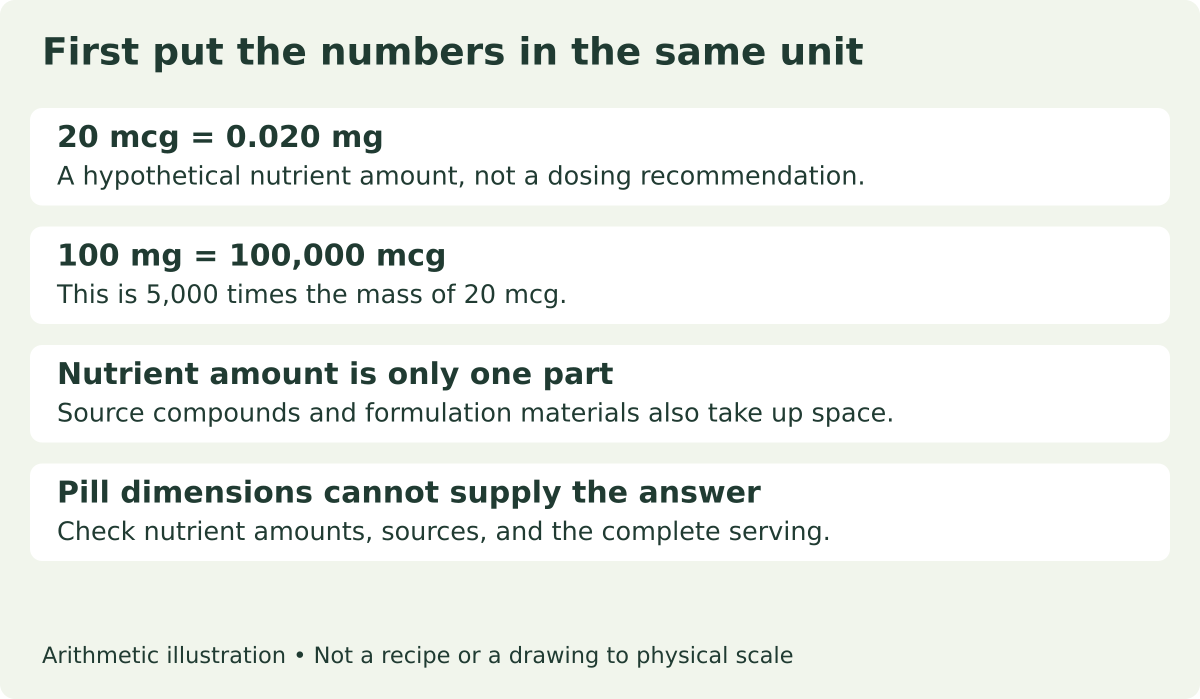
Imagine a hypothetical label containing 100 milligrams of one nutrient and 20 micrograms of another. One milligram equals 1,000 micrograms, so 20 micrograms equals 0.020 milligrams. The 100-milligram amount has 5,000 times the mass. [1]
Those are arithmetic examples, not recommended doses or a real formula. Their purpose is to show why counting nutrient names does not tell you total nutrient mass. Adding several microgram-level entries may add relatively little mass beside an ingredient measured in hundreds of milligrams.
| Hypothetical amount | Same amount in milligrams | What it shows |
|---|---|---|
| 20 mcg | 0.020 mg | A large-looking number may describe a tiny mass. |
| 1,000 mcg | 1 mg | The unit changes the meaning of the number. |
| 100 mg | 100 mg | This is 100,000 mcg. |
Percent Daily Value does not solve the size puzzle either. It compares an amount with a nutrient-specific reference value, not with a common physical volume. Two nutrients can both show 100% Daily Value while contributing very different masses. [2]
The single-nutrient pill may supply a different amount
A separate vitamin C, calcium, or magnesium supplement may provide a different amount from the corresponding entry in a multivitamin. “Contains calcium” and “provides the same calcium amount as this separate product” are different statements.
NIH notes that multivitamin/mineral formulas vary and often provide relatively small amounts of calcium, magnesium, and potassium. [3] That makes it especially important to read the actual panel rather than imagining a full standalone supplement behind every nutrient name.
For example, a hypothetical multi with 50 mg of a nutrient and a separate product with 250 mg do not need to allocate the same amount of space to that nutrient. This comparison says nothing about which amount is appropriate for you.
The nutrient amount is not the whole ingredient weight
Mineral labels add another layer. “Calcium (as calcium carbonate)” identifies calcium and its source compound. FDA’s labeling guidance says the declared calcium amount is the calcium weight, rather than the weight of the entire calcium carbonate ingredient. [2]
The rest of the source compound still occupies physical space. Consequently, adding all the nutrient numbers on a panel will not reliably reconstruct the total tablet weight. Source ingredients and other formulation materials must also be considered.
The same caution applies to judging a product by weighing it on a kitchen scale. A scale cannot separate the nutrient from its source compound, coating, capsule shell, or other ingredients, and it cannot confirm label accuracy.
A pill is a manufactured form, not just a pile of vitamins
Tablets and capsules need a workable physical structure. Depending on the product, supporting ingredients can help the mixture flow through manufacturing equipment, hold a tablet together, or help it break apart after swallowing. A capsule also has a shell; some tablets have coatings.
Tufts describes blending powdered nutrients with formulation ingredients, then compressing the mixture into tablets or filling capsules. [4] This explains why a single-nutrient product may be much larger than the nutrient’s own mass would suggest.
When reading Other Ingredients, ask what each material contributes to that dosage form. A nutrient source, a tablet binder and a capsule shell have different jobs. Keeping those roles separate helps explain the physical product as well as the nutrient amounts.
Physical volume also depends on the materials and how they are packed. Two mixtures of the same mass need not occupy identical volumes. Tablet compression and capsule filling can produce different forms. Those general principles do not let us calculate the composition of an unknown pill from its dimensions.
Check whether the serving is one pill
A bottle labeled “multivitamin” may direct you to take more than one tablet or capsule per serving. If its Supplement Facts panel gives amounts for a two-capsule serving, comparing one capsule with a single-tablet product gives a misleading picture.
Start at the Serving Size line, then compare like with like. Our per-serving versus per-capsule guide explains that arithmetic in more detail.
What to compare instead of pill size
- The full serving: How many tablets, capsules, or measured units do the listed amounts describe?
- The same nutrient and unit: Compare milligrams with milligrams, or convert micrograms carefully.
- The named source: Keep the nutrient amount separate from the ingredient supplying it.
- The rest of the formula: Read Other Ingredients and any additional dietary ingredients.
- Your actual purpose: Use the label and qualified advice to evaluate suitability, rather than interpreting a bigger pill as a better product.
A similar size is therefore no contradiction. A multi can combine many small nutrient amounts, while a standalone product may contain more of one nutrient or use a different physical formulation. Neither size nor number of ingredients establishes absorption, safety, potency, or overall quality.
For a broader introduction to formula categories, see what a comprehensive multivitamin means. The physical-size question here has a narrower answer: count the amounts and understand the materials, rather than counting the nutrient names.
References
- NIST: Metric (SI) Prefixes
Basis of unit conversions. - FDA: Dietary Supplement Labeling Guide, Chapter IV
Used for nutrient/source weight, serving information, and the definition of %DV; old numeric DV examples are not reused. - NIH Office of Dietary Supplements: Multivitamin/mineral Supplements — Health Professional
Formula variability and often-small amounts of certain minerals. - Tufts Health & Nutrition Letter: How are multivitamins made?
Used for manufacturing and formulation ingredients only; broad absorption/excretion statements are not adopted.
Educational information; individual product questions should be reviewed with the manufacturer or a qualified healthcare professional.
Optional: explore Mother Earth Labs
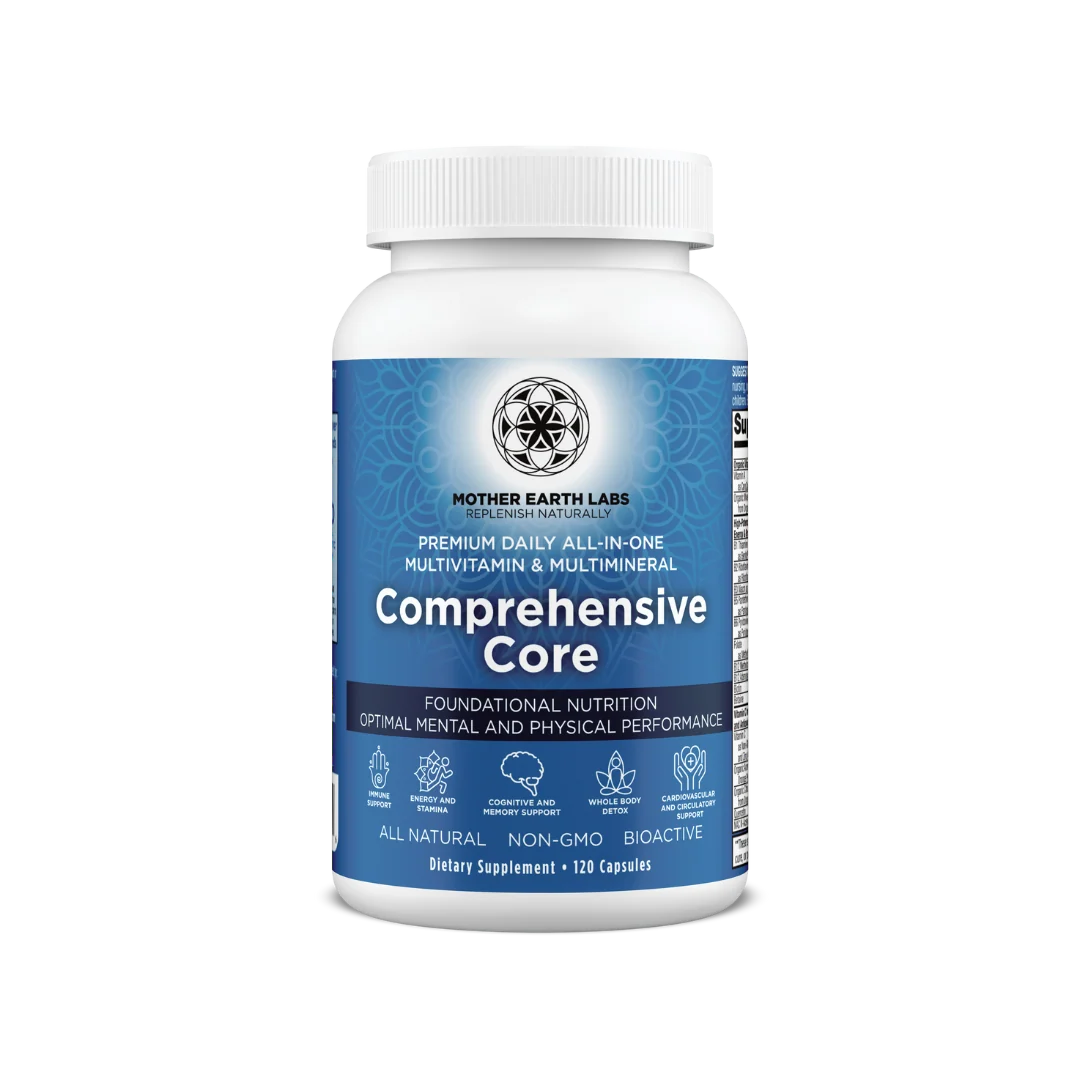
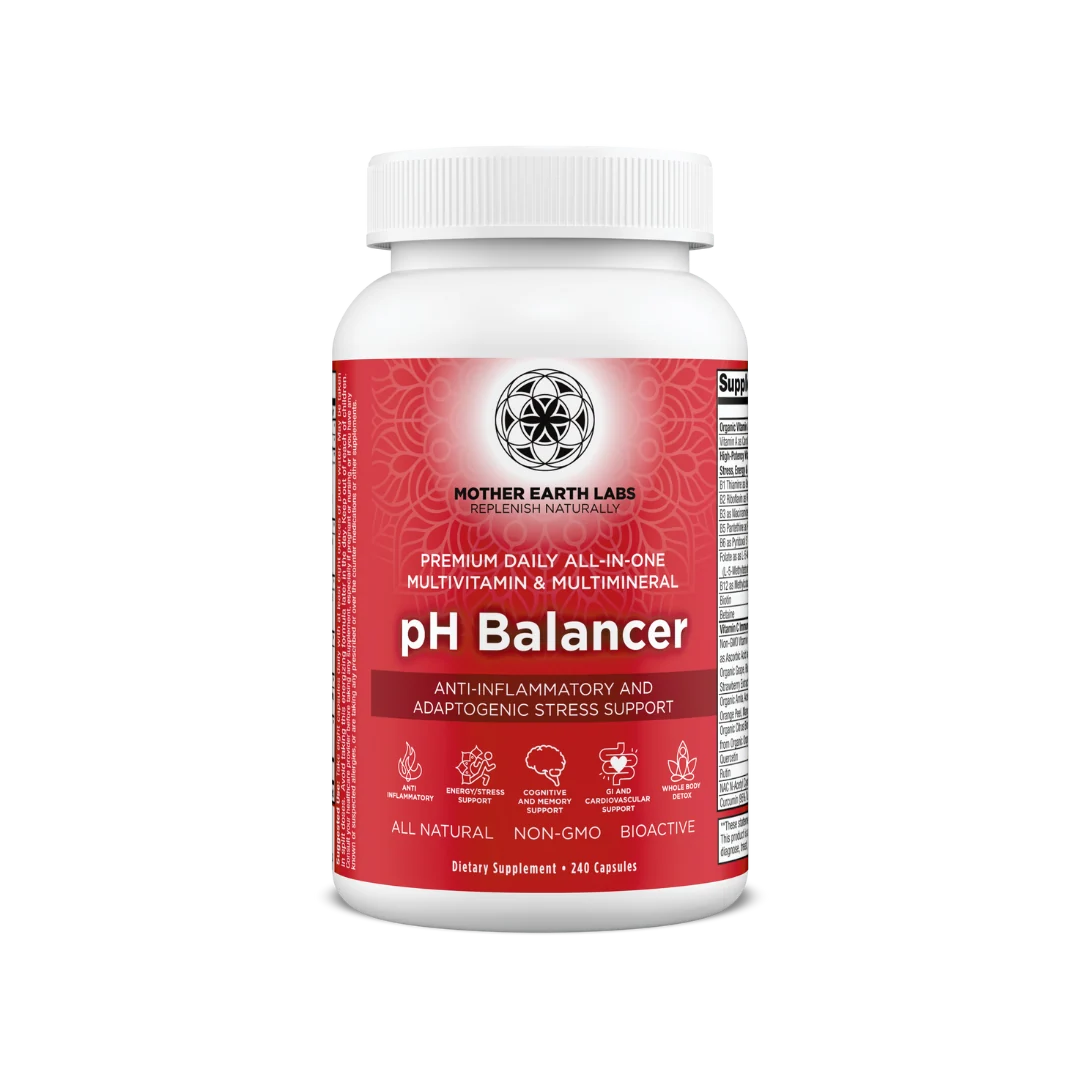
If you would like to explore the products featured elsewhere on Core & Balancer, Mother Earth Labs offers Affiliate DisclosureComprehensive Core capsules Affiliate Disclosure and pH Balancer capsules Affiliate Disclosure. These are two different multivitamin/mineral formulas with additional ingredients. Read the current label for the exact formula, serving directions, and suitability.
Affiliate Disclosure Affiliate DisclosureUse the linked product pages to examine serving counts, nutrient amounts and source names in real formulas. Those details connect the pill-size question with the label-reading method in this article.