
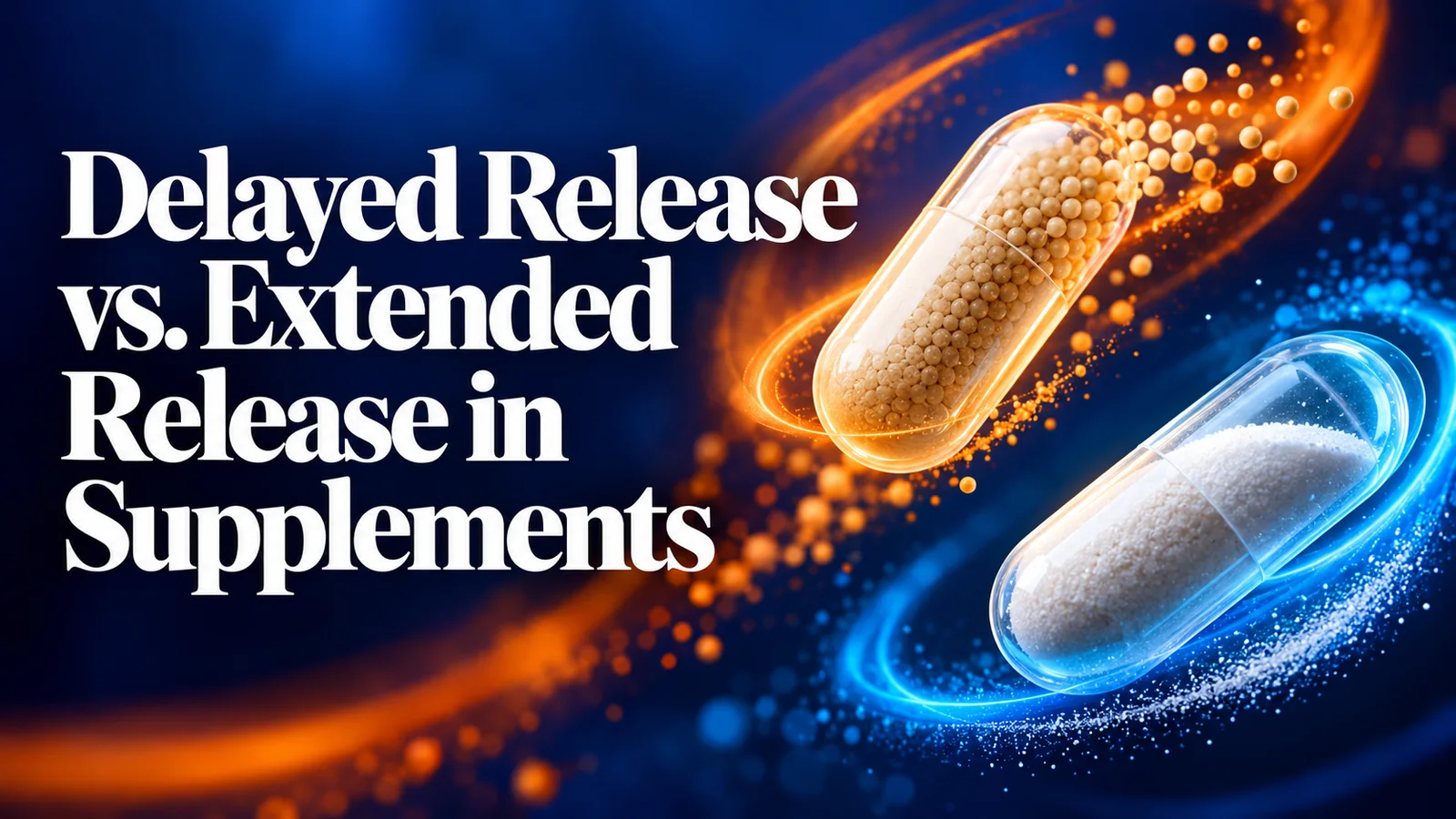
Delayed release describes a delay before release begins; extended release describes release spread over time. They are different claims. A capsule that opens later does not necessarily release nutrients gradually for hours, and the abbreviation on a bottle does not by itself show how the finished product was tested.
Ask for the evidence behind the timing claim
For a claim such as release over several hours, ask whether the evidence concerns the finished supplement, an ingredient, or the capsule shell alone. Then ask what was measured: release in a laboratory test, blood levels, or an actual health outcome. Those are useful but different kinds of information.
That distinction matters when reading supplement packaging. A short abbreviation can sound like a complete performance claim, even though it leaves several practical questions unanswered.
Separate the start from the duration
FDA’s pharmaceutical Q6A glossary distinguishes delayed release from extended release, with both falling under modified release. Those drug definitions provide a useful vocabulary; citing them does not mean a supplement has undergone drug approval or demonstrated the same performance. [1]
| Wording | Question it addresses | What it does not tell you by itself |
|---|---|---|
| Delayed release | Does release start later than immediately after swallowing? | How slowly the contents release after that delay |
| Enteric or gastro-resistant | Is the dosage form designed to resist gastric conditions? | Its exact opening location or timing in every person |
| Extended release | Is availability from the dosage form extended over time? | An exact number of hours, absorption percentage or clinical benefit |
| DR or ER | Which term does this manufacturer mean? | A universal definition of that abbreviation across all supplement labels |
Imagine two fictional designs. One stays intact initially, then releases its contents relatively quickly. Another begins releasing earlier but continues gradually. Both modify release; they do not do the same thing. This example describes possibilities, not a test result for any commercial capsule.
A capsule shell and a finished formula are different evidence questions
A manufacturer may describe a shell, coating or delivery ingredient as resistant to particular conditions. Ask whether the evidence concerns that empty shell, a model ingredient inside it, or the actual finished supplement. The material inside and the test conditions matter when interpreting a result.
An original laboratory study of gastro-resistant coatings tested release under specified acidic and higher-pH conditions. It illustrates why a meaningful release statement needs a method and conditions. It does not provide a release schedule for an unrelated finished supplement. [3]
A photo of an intact capsule in a glass of water is particularly limited evidence. Plain water does not reproduce all gastric and intestinal conditions. Nor does seeing a capsule break apart tell you how much of each ingredient dissolved or entered the bloodstream.
Keep three stages separate
Disintegration concerns the dosage form breaking apart. Dissolution concerns material going into solution under the test conditions. Absorption concerns movement into the body. A result at one stage should not be silently relabeled as a result at another.
FDA’s supplement manufacturing guidance says the CGMP rule does not require manufacturers to establish dissolution, disintegration or bioavailability specifications. It also says that when such specifications are established, data should support them. A general manufacturing-quality claim is therefore not a substitute for the specific release evidence you want to evaluate. [2]
Ask a more useful question than “Is it slow release?”
Try: “What does this release term mean for this finished product, and what test supports that statement?” Follow with the tested formulation, conditions, measured ingredient and time points. If a precise duration is advertised, look for evidence supporting that duration rather than supplying it yourself.
Longer release is not automatically better for every ingredient or every purpose. Delayed opening is not proof of greater absorption, and greater absorption is not proof of a better health outcome. Those are separate claims requiring appropriate evidence.
Read the actual use instructions before opening, crushing or otherwise altering a dosage form. If swallowing is difficult, ask the manufacturer or pharmacist whether that particular product can be changed or whether another format is available. A delivery design may depend on the form remaining intact.
The most useful label reading is modest and precise: identify the intended start, the intended duration and the evidence supplied for each. That is enough to avoid turning “delayed” into “all day” or a delivery description into an unsupported promise.
Sources
- FDA. ICH Q6A: glossary definitions of delayed, extended and modified release; drug-product guidance.
- FDA. Dietary Supplement CGMP Small Entity Compliance Guide: dissolution specifications and supporting data.
- Gastro-resistant characteristics of GRAS-grade enteric coatings for pharmaceutical and nutraceutical products. Original laboratory study, 2015.
Pingback: Magnesium ER vs. Ionic Magnesium+: Serving Comparison