

Product and label review: October 24, 2026. By Dr. Rich Prather, D.C.
Bone Armor Boost is MEL’s focused strontium-citrate formula, with one declared active entry and a two-capsule serving. It is designed as a companion option within the Bone Armor range. This guide explains its label, how citrate research fits the discussion, and what your bone-health team should know when interpreting a DXA scan.
In this guide
Take the exact product name to the scan conversation
If you use a strontium-containing supplement, tell the clinician interpreting your DXA scan which compound and product you use. A change in the scan number needs that context. The result should not be described as a direct measurement of the same change in bone strength or fracture protection.
Start with the distinction between the two product names: Bone Armor supplies calcium and accompanying nutrients; Bone Armor Boost supplies strontium citrate. Understanding that difference makes the ingredient, timing and research sections below easier to follow.
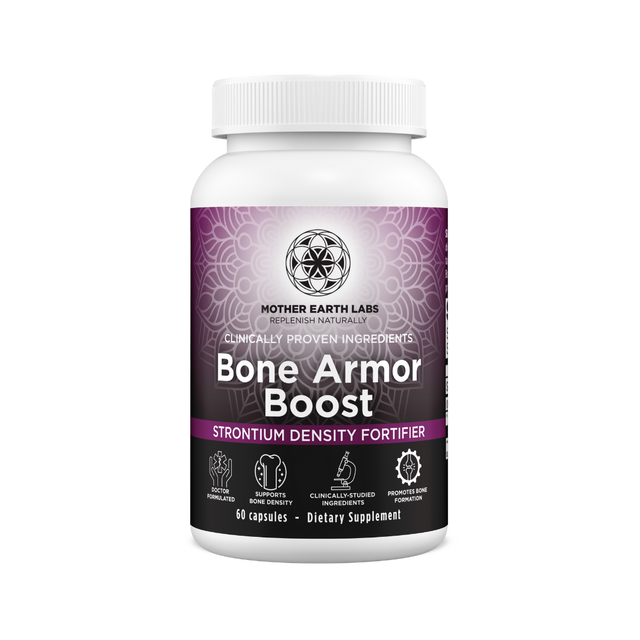
Affiliate DisclosureBuy Now — Bone Armor Boost Strontium Citrate Capsules – Bone Density Support Affiliate Disclosure. Check the current label, availability and purchase options before ordering.
A deliberately short ingredient list
The current label lists a two-capsule serving and 30 servings per 60-capsule bottle. The Supplement Facts entry is strontium citrate, 620 mg. Other ingredients are vegetable capsules.
The wording matters. The reviewed panel does not explicitly identify that 620 mg as elemental strontium. It should therefore be reported as the declared strontium citrate entry, rather than silently relabeled elemental strontium. Anyone comparing it with a study or another brand should first establish whether both numbers describe the same thing.
| Label entry | Amount per serving |
|---|---|
| Serving size | 2 capsules |
| Strontium citrate, as declared | 620 mg |
| Servings per bottle | 30 |
What makes strontium different from calcium
Strontium and calcium are related elements, but they are not interchangeable nutrients. Calcium is an essential structural mineral in bone, with established dietary intake recommendations. Strontium does not replace the need for calcium, adequate protein, vitamin D or normal bone-health assessment.
Bone is living tissue that is continually remodeled through the coordinated work of bone-forming and bone-resorbing cells. Researchers study strontium compounds in that setting. For this guide, the relevant preparation is strontium citrate, the form declared on the Boost label.
MEL positions Boost as a companion to its calcium-containing Bone Armor formula. If the pair is part of your clinician-guided plan, the manufacturer provides a specific timing instruction: keep Bone Armor at least two hours apart from Boost. The schedule section below explains that instruction.
What the citrate research actually studied
The Melatonin-Micronutrients Osteopenia Treatment Study, or MOTS was a one-year randomized study in postmenopausal women with osteopenia. Its regimen combined melatonin, strontium citrate, vitamin D3 and vitamin K2. The investigators reported improvements in measured bone-density outcomes with the combined intervention.
The study offers a human research connection for the citrate form as part of a combined regimen. Because melatonin, strontium citrate, D3 and K2 were given together, its result applies to that combination. It does not isolate the contribution of strontium or establish fracture reduction from Boost alone.
Much better-known strontium research concerns strontium ranelate, a different compound used as a drug in some settings. Those drug findings should not be copied onto a strontium citrate supplement. Matching the compound is as important as matching the dose.
A helpful conversation before a DXA scan
Strontium absorbs X-rays differently from calcium. When it is incorporated into bone, it can raise the apparent bone-mineral-density result measured by DXA. A higher scan value can therefore reflect both biological change and a measurement effect.
A laboratory study of strontium and DXA measurements demonstrated the relationship between strontium content and apparent density. For someone tracking bone health, the practical step is simple: tell the ordering clinician and scanning team about strontium use, including product, amount and dates.
This helps the team compare results intelligently. It also keeps the goal focused on bone health and fracture risk, rather than treating a larger scan number as a complete picture of stronger bone.
Manufacturer directions and timing with calcium
The label advises two capsules before bedtime, or practitioner direction. It also instructs users to avoid taking Bone Armor within two hours of Bone Armor Boost. If a clinician recommends the pair, a morning/evening calcium routine and a separate bedtime Boost routine may help follow that instruction.
Do not assume the two-hour statement settles every medication interaction. A pharmacist can review prescriptions and the full supplement list. People with kidney disease, cardiovascular conditions or a diagnosed bone disorder should make the choice with their clinician rather than adding strontium solely in response to an online claim.
The bottle also carries a two-year-from-manufacture use instruction. Check the date printed on the actual container and follow its current directions.
How to make the comparison useful
Begin by distinguishing Bone Armor Boost from Bone Armor itself. Next, compare the exact declared chemical form and the basis of its milligram amount. Finally, ask what outcome matters in the individual plan: nutritional adequacy, maintaining bone mass, understanding a scan or treating a diagnosed disorder are related but different goals.
Food intake, resistance and weight-bearing activity, balance and fall prevention all contribute to a broader bone-health plan. A targeted supplement is easier to evaluate when you and your clinician have identified its role alongside those habits.
Questions to resolve before ordering
Is Boost a calcium supplement? No. Its declared active entry is strontium citrate.
Can I take it at the same time as Bone Armor? The manufacturer advises separating the two by at least two hours.
Can I judge success only from a DXA increase? No. Strontium changes X-ray attenuation, so the clinical team needs to know about its use.
The short formula makes the comparison straightforward: one declared compound, a two-capsule serving and specific timing guidance within the manufacturer’s range. Bring that label, your calcium routine and any previous scan information to the professional guiding your bone-health plan.
Related reading
Continue with our guide: Supplement Facts Per Serving vs. Per Capsule: A Practical Guide.
Explore our nutrient dictionary: Strontium citrate, Calcium.
Sources and further reading
MOTS: combined melatonin and micronutrient trial
Strontium effects on DXA bone-density measurements
Educational information about nutrition and product use. Supplements are not intended to diagnose, treat, cure or prevent disease; individual needs and responses vary.