

Fulvic acid is the name given to a diverse fraction of naturally occurring organic substances that remains soluble across the acidic and alkaline conditions used to classify humic materials. It is associated with the transformation of plant and microbial remains in soils, waters, sediments, and certain deposits. Its ability to interact with mineral ions helps explain its place in environmental research and nutritional formulations.
Picture the ground beneath a tree in autumn. Leaves collect, roots grow and die, and a community of organisms transforms the material. What looks like an ordinary forest floor contains a continuing exchange of carbon, water, organic compounds, and minerals. Fulvic substances are part of this remarkable natural story.
Understanding that story makes a supplement label easier to read. You can distinguish fulvic acid from an essential mineral, appreciate the chemistry, and compare products according to what their actual formulations contain.
What are humic substances?
Humic substances are complex organic mixtures associated with transformed organic matter. They are not one molecule with a single fixed formula. Scientists use extraction and analytical methods to study their shared characteristics and their variation.
Humus is the dark, well-decomposed organic component commonly associated with soil. Soil organic matter includes more than humus: it also includes living organisms, fresh residues, and material at different stages of transformation. That distinction helps explain why a handful of soil is a living system rather than a container of one chemical.
The USDA soil-health glossary introduces these components. For the chemical classification itself, the IUPAC fulvic-acid definition focuses on solubility.
Humic and fulvic acid: nature’s remarkable process of transforming organic matter
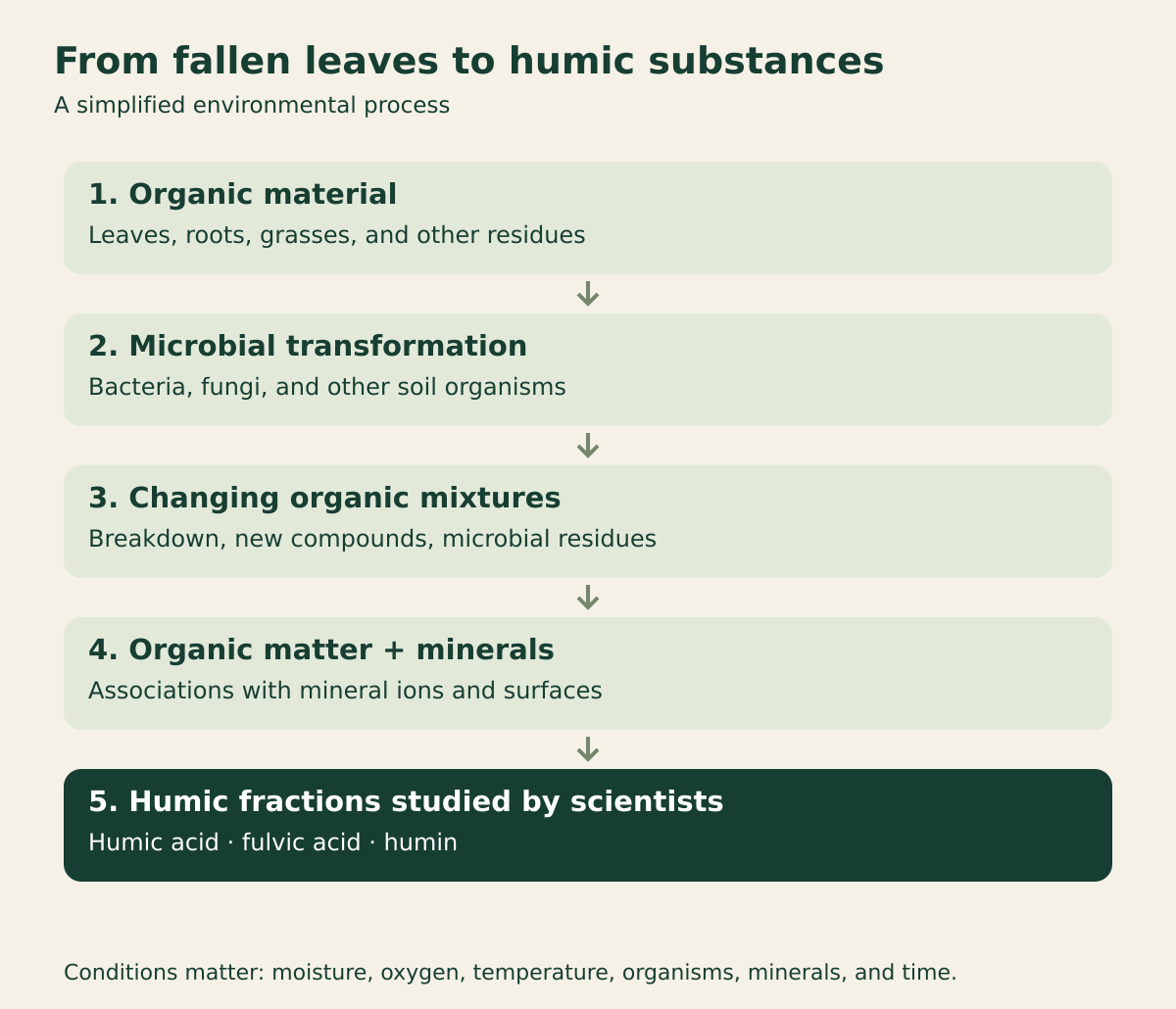
Nature continually recycles yesterday’s plant material into components of tomorrow’s soil. The process is not a factory recipe with one beginning, one temperature, and one finished product. Several transformations occur together, and the surrounding environment influences what remains.
- Organic material arrives. Leaves, roots, grasses, wood fragments, and other residues become part of the soil environment.
- Organisms get to work. Bacteria, fungi, and other soil organisms use and transform organic material. Some carbon is released through respiration, while other material enters new organic compounds.
- Chemistry continues. Compounds are broken down, altered, associated with one another, or incorporated into microbial residues.
- Minerals join the picture. Organic compounds interact with mineral surfaces and dissolved ions, influencing retention and movement.
- Different pools persist. Some materials cycle quickly; others remain associated with soils, sediments, peat, or geological deposits for longer periods.
Humification is the traditional term for transformations associated with humic materials. Moisture, oxygen, temperature, microorganisms, source material, and time influence the process. A wetland and a well-aerated garden bed provide different settings. There is no single age that every fulvic substance must reach.
USDA’s National Agronomy Manual describes the environmental factors and decomposition processes. The diagram below is a simplified environmental explanation, not a manufacturing flowchart.
Where does fulvic acid come from?
Humic and fulvic materials occur in several connected environments. The sources illustrate natural diversity; they do not establish the source of any particular supplement.
| Environment | What makes it relevant |
|---|---|
| Fertile soils and humus | Plant and microbial material interacts with minerals and water |
| Forest floors | Leaf litter, roots, and decomposing vegetation contribute organic material |
| Peat and wetlands | Water conditions influence decomposition and organic accumulation |
| Sediments | Organic matter and mineral particles accumulate and transform |
| Rivers, lakes, and some groundwater | Dissolved and particulate organic matter moves through aquatic systems |
| Leonardite and certain oxidized lignite deposits | Geological organic materials can provide sources for extraction |
The International Humic Substances Society maintains reference materials from sources including soil, peat, leonardite, and the Suwannee River. It also describes an Antarctic aquatic fulvic reference derived from microbial material in an environment without terrestrial plants. This is a useful reminder that the story includes microbial as well as plant contributions. Explore the actual IHSS source materials.
When someone asks “where is humic acid found?” the answer is therefore broader than one deposit. For a product, ask the next question: which source did this manufacturer use, and how was the final preparation characterized?
A brief history of humic-substance research
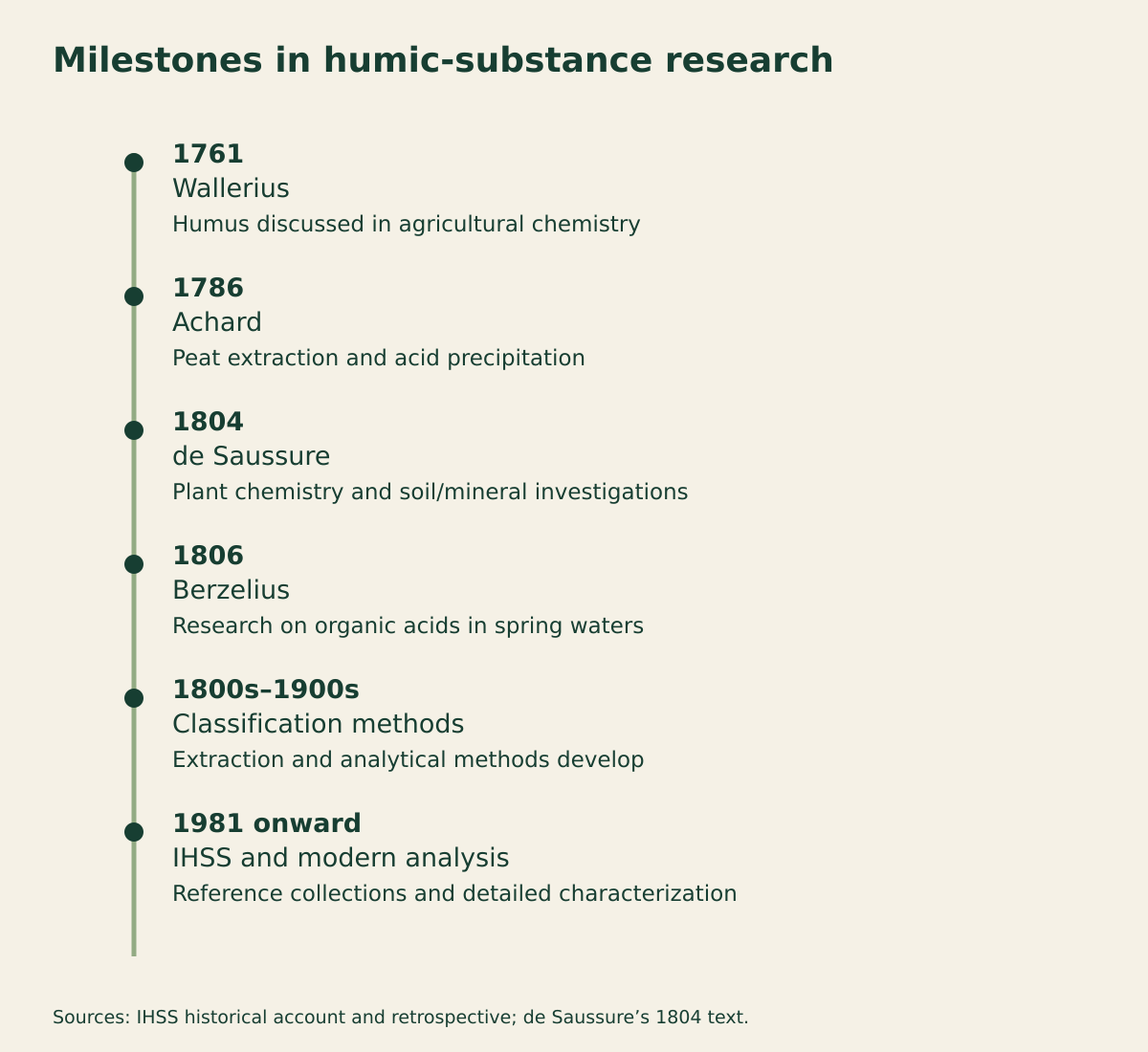
People valued dark, productive soils long before the methods of modern chemistry. Over time, researchers moved from observing soil fertility to separating fractions and studying their composition. The milestones below show that progression.
- 1761 — Wallerius: Johan Gottschalk Wallerius discussed humus in Agriculturae fundamenta chemica, an early agricultural-chemistry text.
- 1786 — Achard: Franz Karl Achard reported treating peat with potassium hydroxide and obtaining a dark precipitate after acidification. This helped establish experimental separation of organic material.
- 1804 — de Saussure: Théodore de Saussure published Recherches chimiques sur la végétation, with investigations of plant chemistry, soil extractives, and mineral constituents. This belongs to the wider development of plant-nutrition science.
- 1806 — Berzelius: Research on Swedish spring waters extended investigation into aquatic organic acids.
- 1800s–1900s: Extraction and classification methods developed, making different organic fractions easier to compare.
- 1981 onward: Formation of IHSS and development of reference collections improved comparison across laboratories.
The early chronology is documented in the IHSS historical account; de Saussure’s 1804 text is available as a digitized original. The IHSS retrospective explains the reference collection. Modern spectroscopy and other analytical techniques continue that work by examining the mixtures in greater detail.
Humic acid vs fulvic acid vs humin
These names refer to fractions defined using separation behavior. The word “acid” is part of a chemical classification; it does not tell you how a preparation will affect a person’s blood pH.
| Fraction | Traditional separation distinction | What to remember |
|---|---|---|
| Humic acid | Extracted under alkaline conditions and precipitates with strong acidification, conventionally around pH 1 | A diverse mixture rather than one standard molecule |
| Fulvic acid | Remains in solution under the acidic and alkaline conditions used in separation | Composition depends on source and isolation |
| Humin | Residual fraction not extracted by the strong acid/base methods used for the other fractions | Part of the traditional soil-organic-matter classification |
The IHSS explanation sets out these distinctions. A simple fixed molecular-size cutoff is not an adequate definition. Average size, functional groups, and composition can vary among samples.
Humic acid and fulvic acid are related members of the wider humic-substance discussion. They are not interchangeable names for a single ingredient. A combination product should identify the combined material accurately, and a combined amount should remain combined unless separate amounts are actually declared.
Why fulvic substances interact with minerals
Organic molecules can contain functional groups with oxygen atoms that interact with metal ions. Carboxyl groups are one important example. Their charge and behavior change with conditions such as acidity. Researchers study these features to understand mineral binding, movement, and reactivity.
Imagine a mineral ion in a solution containing organic ligands. An association can change how that mineral behaves compared with the unassociated ion. The outcome depends on the metal, the ligand, competing substances, and the environment. The useful lesson is that “binding” is a specific chemical event whose consequences must be measured.
Complexation is the broader association of a metal ion with ligands. Chelation is a particular arrangement involving multiple binding sites on a ligand. These words explain chemistry; they do not automatically describe delivery across the human intestinal wall.
USGS research has characterized carboxyl groups in humic substances and examined fulvic substances associated with trace metals in a stream. These are examples of environmental investigation, with endpoints appropriate to those systems.
Fulvic acid and trace minerals: three distinct questions
First, which minerals are present? Second, how do they interact with the organic preparation? Third, what happens when people consume the preparation? Each question needs its own information.
A label can name naturally occurring minerals without quantifying each one. A laboratory analysis can characterize a sample under stated conditions. A human study can examine absorption, nutritional status, tolerability, or a clinical outcome. The methods and measurements determine the conclusion.
For essential mineral functions and dietary requirements, continue to What Are Trace Minerals?. Fulvic acid itself is not one of those essential mineral elements, and a fulvic-acid amount is not a substitute for a declared zinc, iodine, or magnesium amount.
Fulvic acid benefits: what has research actually examined?
Interest in fulvic acid benefits includes mineral interactions, biological activity, and tolerability. The strongest way to explain this work is to name the preparation and the endpoint. “Fulvic acid” is a broad category, so the identity of the tested material matters.
A small phase 1 study enrolled 30 men with allergic sensitivity and evaluated a carbohydrate-derived fulvic preparation. Twenty-one completed the trial. Investigators examined short-term safety and skin-prick responses and reported a change in the latter. This was an early investigation of a defined material, not a trial of the finished Mother Earth Labs products described below. Read the original phase 1 study.
A separate exploratory trial examined a topical carbohydrate-derived fulvic preparation in 36 participants with eczema. Some measures improved, supporting further investigation of that topical preparation. Application to skin and oral nutritional supplementation answer different questions. Read the topical study.
Animal research explores additional biological questions. For example, a study in broiler chickens examined growth, blood measures, antioxidant-related endpoints, and intestinal microorganisms. Such work helps develop research questions; it is not a human mineral-absorption result. See the original animal study.
These distinctions let you appreciate the scientific interest without assigning every proposed effect to every bottle. Ask which preparation, population, dose, and outcome support the particular claim you want to understand. Our bioavailability guide explains how to interpret those measurements.
How are commercial preparations produced?
Natural formation and commercial production are separate stages. Manufacturers can select a source material, extract or separate organic fractions, purify or concentrate the preparation, and incorporate it into a finished product. Processing choices and the source influence the final composition.
Laboratory reference methods are not automatically a manufacturer’s recipe. IHSS describes the methods used to isolate its scientific standards and explicitly distinguishes that purpose from recommending one best commercial method. Read the IHSS isolation explanation.
For product quality, useful documentation identifies the actual material, analytical method, relevant contaminant testing, and the batch or specification represented. A concentration figure needs its measurement basis. “More concentrated” becomes meaningful when you know what is being measured and per which serving.
What Mother Earth Labs says about its source
In its Fulvic 400X manufacturing discussion, Mother Earth Labs identifies humate raw material from the Fruitland Formation in northwestern New Mexico. It describes a proprietary separation process using purified water and the addition of specified electrolyte ingredients. These are the company’s descriptions; the article does not independently reconstruct the proprietary process.
The source account concerns the products identified in that manufacturer discussion. It should not be extended to every unrelated ingredient in every MEL formula. Use the current label to establish the finished product’s composition. Read MEL’s source and processing account.
From nature to modern Mother Earth Labs formulations
Humic and fulvic substances have been part of the natural environment for countless generations. Today, their fascinating chemistry continues to inspire research and the development of specialized nutritional formulations. Understanding where they come from and how they interact with minerals provides a useful foundation for exploring the different Mother Earth Labs products.
The current family includes humic/fulvic-focused preparations and combination formulas. The tables distinguish each formulation from its container choices. Relevant label entries are shown as written or summarized faithfully; combined entries remain combined, and a liquid volume is not relabeled as a pure dry-acid weight.
Humic/fulvic-focused and core nutritional formulas
| Product / formula | Relevant verified label entries | Forms and presentations | Formulation focus |
|---|---|---|---|
| Comprehensive Core liquid | 25 mg combined humic/fulvic extracts per 1 fl oz; vitamins, minerals, plant blends | Gallon; dispensing, glass, and round quarts | Broad daily nutritional support |
| Comprehensive Core capsules | 25 mg combined humic/fulvic entry per 4 capsules; vitamins, minerals, plant blends | 120 capsules; 30 full servings | Broad daily nutritional support |
| pH Balancer liquid | Humic/fulvic extracts within GI blend; amount not separately declared; vitamins, minerals, botanicals | Gallon; dispensing, glass, and round quarts; 1 fl oz serving | Multivitamin/mineral and botanical formulation |
| pH Balancer capsules | 40 mg combined humic/fulvic substances per 8 capsules; vitamins, minerals, botanicals | 240 capsules; 30 full servings | Multivitamin/mineral and botanical formulation |
| Humic & Fulvic regular liquid | Combined humic/fulvic preparation including naturally occurring macro and trace ionic minerals; 1 fl oz serving | Gallon; dispensing, glass, and round quarts | Combined humic/fulvic-focused preparation |
| Humic & Fulvic SC drops | Combined humic/fulvic preparation including naturally occurring macro and trace ionic minerals; 1 mL serving | 4 oz / 120 mL dropper | Small-volume combined preparation |
| Humic & Fulvic SC capsules | 325 mg combined humic/fulvic acids per capsule, including naturally occurring minerals | 90 capsules | Counted capsule presentation |
| Fulvic 400X | 1,000 mg fulvic acid solution per 1 mL; naturally occurring fulvic ionic minerals; purified water | 4 oz / 120 mL dropper | Concentrated fulvic/mineral preparation |
| Fulvic Detox | Demineralized fulvic liquid; panel names a 1 fl oz preparation entry, not pure dry-acid mass | Gallon; dispensing and glass quarts | Fulvic-focused demineralized preparation |
Additional formulations containing humic or fulvic ingredients
| Product / formula | Relevant verified label entries | Forms and presentations | Formulation focus |
|---|---|---|---|
| Essential MultiVitamins capsules | 25 mg fulvic trace minerals per 4 capsules; vitamins, minerals, plant ingredients | 120 capsules | Daily multivitamin/multimineral option |
| Essential MultiVitamins liquid | 25 mg fulvic trace minerals per 1 fl oz; vitamins, minerals, plant ingredients | Dispensing, glass, and round quarts | Daily liquid multivitamin/multimineral option |
| Live Active Core Daily | 40 mg humic/fulvic acid NBD per 6 capsules; vitamins, minerals, botanical ingredients | 180 capsules | Multivitamin/mineral combination |
| OrganiEarth | 100 mg combined humic/fulvic acids per scoop; vitamins, minerals, greens, fiber and other ingredients | 720 g canister or pouch; 30 servings | Greens and multinutrient powder |
| GI UltraMAX | 100 mg humic/fulvic extracts per scoop; L-glutamine, colostrum, zinc-carnosine and other ingredients | Powder; 30 servings | Digestive-support combination |
| Advanced Detox Support | 200 mg fulvic/humic NBD per 4 capsules; TUDCA, NAC, glutathione and botanicals | 120 capsules | Specialized combination; compare full panel |
| Advanced Immune Support | 100 mg humic/fulvic extracts per 6 capsules; vitamins C and D3, zinc, elderberry and other ingredients | 180 capsules | Immune-oriented nutritional combination |
| Bone Armor | 100 mg fulvic trace mineral complex per 6 capsules; calcium, magnesium, vitamins D3/K2 and other ingredients | 180 capsules | Bone-nutrition combination |
| Live Active Ageless ME | 100 mg fulvic trace minerals/elements per 6 capsules; collagen peptides and other ingredients | 180 capsules | Skin/hair/nail-oriented combination |
| CardioExcel | 50 mg fulvic electrolyte/trace-mineral group per stick; Nitrosigine, citrulline, CoQ10 and other ingredients | 30 powder sticks | Performance-oriented combination |
| SportActive | 100 mg fulvic trace minerals/electrolytes per stick; declared sodium, potassium, magnesium and other ingredients | 25 powder sticks | Electrolyte/hydration formulation |
| Ionic Magnesium+ | 50 mg elemental magnesium per 1 mL; fulvic minerals super concentrate listed among other ingredients | 4 oz / 120 mL dropper | Measured magnesium with fulvic preparation |
| Lugol’s Iodine liquid | Lugol’s iodine solution and black fulvic acid; 70 mg black fulvic entry per about 20 drops | 2 oz dropper | Iodine-focused formulation; use individualized guidance |
| MagnesiumER | 50 mg fulvic acid per 4 capsules; 350 mg magnesium from seven forms, vitamins D3/B6 and zinc | 120 capsules | Magnesium-focused combination |
For each product, the linked guide and manufacturer panel provide the complete ingredients and directions. The tables identify the humic/fulvic component and the formulation’s broader purpose; they are not full ingredient inventories or individualized treatment recommendations.
Comprehensive Core and pH Balancer: compare their distinct liquid and capsule panels. Core provides a broad multivitamin/mineral foundation with additional ingredients. pH Balancer combines its nutritional base with a different botanical profile. Their names and shared ingredients do not make the four formulations identical. Use the direct formula comparison and the individual Core and pH Balancer guides.
Fulvic-focused choices: the combined Humic & Fulvic preparation, SC drops, SC capsules, Fulvic 400X, and demineralized Fulvic Detox deserve separate comparisons. Our existing Which One Is Right for Me? guide handles that practical decision.
Both reviewed Core and pH Balancer families list 125 mcg (5,000 IU) vitamin D per full serving, above the U.S. adult upper limit of 100 mcg. Review total intake and suitability with your clinician, particularly before combining formulas.


Choosing liquids, concentrates, capsules, and container sizes
Start with the composition you want to investigate, then choose the presentation. A concentrate can fit a small-volume routine. Capsules offer a counted serving. A quart provides a smaller liquid container, while a gallon provides more volume for an established routine. Measuring and storage directions belong to the exact product.
Container arithmetic is useful when the formula and serving basis match. A U.S. gallon contains 128 fluid ounces and a quart contains 32. At a one-fluid-ounce serving, those volumes correspond to 128 and 32 servings. A bottle used by the milliliter requires its own calculation. This compares supply, not biological effectiveness.
Read the distinction between solution mass and pure ingredient mass. Fulvic 400X lists 1,000 mg of fulvic acid solution per 1 mL; that is the named solution entry. A 325 mg combined humic/fulvic capsule entry is a different declaration. Neither number alone establishes a dose equivalence. The solution-weight guide explains this specific label question.
For a daily routine, ask where the bottle will be stored, whether refrigeration is required, how the serving is measured, and whether you prefer a small bottle or a counted capsule. With combination formulas, compare all nutrients already present in your other products. A pharmacist can review medicine-specific timing; pregnancy, nursing, kidney disease, and relevant thyroid conditions call for individualized advice.
How this connects to nutrient-dense foods
The soil story and the dinner-table story are connected through environmental nutrient cycling and plant growth. They remain distinct nutritional questions. Eating vegetables is not equivalent to consuming a standardized fulvic preparation, and a fulvic product does not reproduce a varied meal’s protein, fiber, and nutrient pattern.
Nutritious foods and appropriately selected supplements can contribute in complementary ways. For meal ideas, food groups, and practical shopping choices, visit What Is a Superfood?. For essential minerals and human requirements, use the trace-mineral guide.
Frequently asked questions
Is fulvic acid a single chemical?
It is a chemically diverse fraction rather than one uniform molecule. The source and processing help determine a preparation’s characteristics.
How is fulvic acid made?
Natural processes transform organic material through biological and chemical activity. Commercial production then obtains and processes selected material into a defined preparation. Those are separate stages.
Is fulvic acid the same as humic acid?
They are related fractions distinguished by solubility behavior under specified separation conditions. A product may contain one or a combination.
Is fulvic acid the same as shilajit?
No. Shilajit is a complex natural material that can contain fulvic substances alongside other constituents. Research on a specific shilajit preparation does not automatically establish an effect for a different fulvic product.
What foods are high in fulvic acid?
There is no established dietary requirement or standardized everyday food table for fulvic acid comparable with zinc or iron. Soil chemistry helps explain plant nutrition, but ordinary food choices are better planned around their established nutrients.
Does fulvic acid increase mineral absorption?
Fulvic substances interact with mineral ions chemically. A specific claim about human absorption requires evidence measuring that outcome with the relevant preparation. Check the study rather than inferring the outcome from binding alone.
What does “fulvic minerals” mean?
It commonly describes a mineral-containing fulvic preparation. The actual label is needed to identify the material and any quantified mineral amounts.
Does a darker liquid mean it is stronger?
Color is not a standardized concentration measurement. Compare the declared preparation, analytical specification, serving, and method.
When should I take a fulvic supplement?
Follow the directions for the exact product and have medicine timing checked when relevant. An unmarked dropperful is not a universal milliliter measure; use an appropriate marked device.
How should I compare product quality?
Look for readable current labels and product-specific testing documentation. Ask what material and batch the report covers and what was measured. Composition, quality testing, and clinical benefit evidence each answer a different question.
Follow the story, then compare the label
Fulvic acid connects an ordinary autumn leaf with some remarkably detailed chemistry. Understanding its origins, classification, mineral interactions, and research gives you a stronger foundation for exploring the available formulations. Keep that curiosity tied to a specific label and a clear purpose, then use the linked food, mineral, and product guides to build the next layer of understanding.