

Trace minerals are minerals the body requires in small amounts to support essential functions, including oxygen transport, enzyme activity, thyroid hormone production, and normal metabolism. Iron, zinc, copper, selenium, iodine, manganese, and molybdenum are important examples. “Trace” describes the amount needed, not the value of the mineral.
You may already recognize calcium and magnesium on food labels. The less familiar names can seem harder to place: what does molybdenum do, where does iodine come from, and what does “ionic” mean on a bottle? Understanding a few distinctions makes mineral nutrition easier to navigate.
Start with three questions: which mineral do I need, how much does my food or supplement provide, and what affects its availability? This guide connects those questions with meals, appropriate testing, humic and fulvic substances, and specific formulation choices.
Trace minerals versus major minerals
Major minerals are needed in larger quantities. They include calcium, phosphorus, magnesium, sodium, potassium, chloride, and sulfur. Trace minerals are needed in smaller quantities, often measured in milligrams or micrograms. Both groups belong within the wider category of micronutrients.
| Category | Examples | Useful distinction |
|---|---|---|
| Major minerals | Calcium, magnesium, potassium, sodium, phosphorus, chloride, sulfur | Larger amounts required; different minerals have different functions |
| Essential trace minerals | Iron, zinc, copper, selenium, iodine, manganese, molybdenum | Small amounts support indispensable physiological processes |
| Other trace elements | Elements present in small amounts in food, water, or natural materials | Being detectable does not automatically make an element an essential human nutrient |
MedlinePlus introduces the mineral groups. Lists can differ because they may include fluoride, chromium, or cobalt under different definitions. Fluoride supports dental health; cobalt is required as part of vitamin B12 rather than as a reason to seek separate cobalt supplements.
Chromium deserves its own explanation. U.S. intake guidance was established in 2001, while subsequent research has questioned whether chromium meets the criteria for an essential human nutrient. NIH describes this scientific distinction. A long list of naturally occurring elements should therefore be read differently from a list of established daily nutritional requirements.
Essential trace minerals: functions and food sources
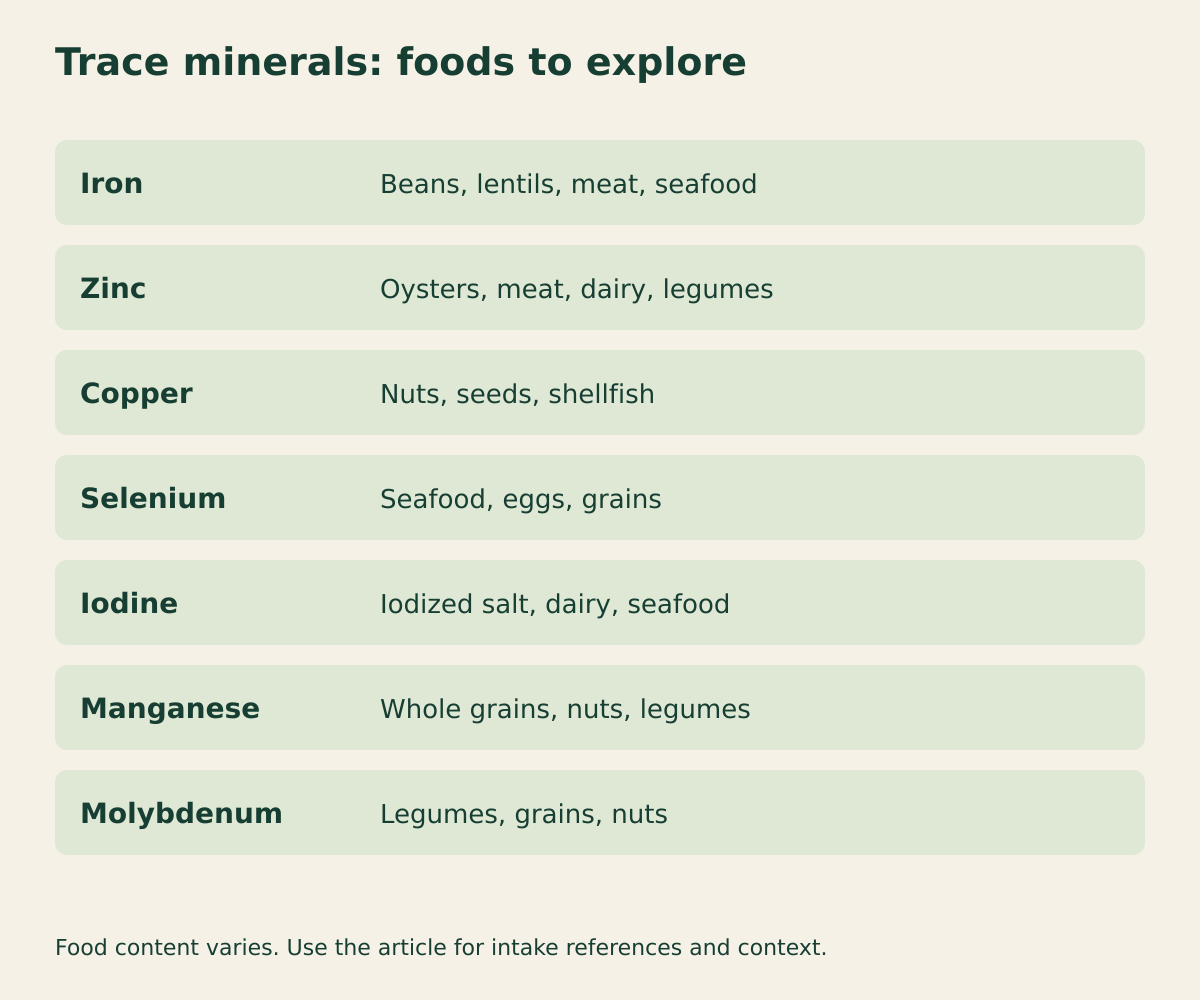
The table below is a practical reference. Food composition varies with the food, serving, growing conditions, and processing. Use variety to build a nutritional pattern rather than expecting one food to supply the entire table.
| Mineral | Normal physiological role | Food sources to explore | Useful consideration |
|---|---|---|---|
| Iron | Hemoglobin, oxygen transport, cellular processes | Meat, seafood, beans, lentils, fortified cereals | Vitamin C supports nonheme iron absorption |
| Zinc | Enzymes, protein and DNA synthesis, immune function | Oysters, meat, dairy, beans, nuts, grains | Long-term high supplemental intake can affect copper status |
| Copper | Iron metabolism, energy-producing enzymes, connective tissue | Shellfish, nuts, seeds, whole grains | Consider alongside high-dose zinc use |
| Selenium | Selenoproteins involved in thyroid metabolism and antioxidant defense | Seafood, eggs, meat, grains, Brazil nuts | Amounts in plant foods vary with soil; Brazil nuts can be very concentrated |
| Iodine | Thyroid hormone production | Iodized salt, seafood, dairy, eggs | Specialty salt is not necessarily iodized; seaweed amounts vary widely |
| Manganese | Enzymes involved in metabolism and antioxidant defense | Whole grains, nuts, legumes, tea | An Adequate Intake is used rather than an RDA |
| Molybdenum | Cofactor for enzymes processing compounds including sulfites | Legumes, grains, nuts, dairy | Dietary deficiency is unusual in ordinary circumstances |
These functions and sources are drawn from the NIH references for iron, zinc, copper, selenium, iodine, manganese, and molybdenum.
How much do adults need?
Recommended Dietary Allowances, or RDAs, describe intakes intended to meet the needs of nearly all healthy people in a defined group. An Adequate Intake, or AI, is used when evidence is insufficient to establish an RDA. Upper limits describe a boundary for usual total intake, not a goal to work toward.
| Mineral | U.S. adult daily reference intake | U.S. adult upper limit |
|---|---|---|
| Iron | Men: 8 mg; women 19–50: 18 mg; women 51+: 8 mg | 45 mg |
| Zinc | Men: 11 mg; women: 8 mg | 40 mg |
| Copper | 900 mcg | 10,000 mcg |
| Selenium | 55 mcg | 400 mcg |
| Iodine | 150 mcg | 1,100 mcg |
| Manganese | AI: men 2.3 mg; women 1.8 mg | 11 mg |
| Molybdenum | 45 mcg | 2,000 mcg |
These are references for nonpregnant, nonlactating adults, using U.S. guidance summarized by NIH. Children and pregnancy/lactation have different values, and a clinician may prescribe a different amount to address a diagnosed problem. Other authorities can set different upper limits; NIH also reports the European adult selenium limit of 255 mcg.
One milligram equals 1,000 micrograms. Keep that unit difference visible when reading a label. A 55 mcg selenium entry and an 11 mg zinc entry cannot be compared simply by looking at which printed number is larger.
Why small amounts matter to normal cellular function
An enzyme can be thought of as a tool that makes a chemical task possible. Some enzymes depend on a mineral cofactor to do their work. The mineral is needed in the right amount and setting; its role is specific.
Iron helps oxygen reach tissues through hemoglobin. Iodine is incorporated into thyroid hormones. Selenium-containing proteins participate in antioxidant defense and thyroid hormone metabolism. Copper and manganese contribute to other enzyme systems. Adequate intake supports this coordinated physiology.
For a practical nutrition decision, identify the missing input rather than assuming more of every mineral improves the whole system. If you already have an adequate intake, the next useful step may be maintaining variety and consistency. If a deficiency is present, a targeted plan can address that specific need.
Superfoods and trace minerals: everyday meals with more nutritional value
Mineral-rich meals need not be complicated. Think in combinations: a legume, a colorful vegetable, a protein food where appropriate, and a grain or other carbohydrate source. Our superfoods guide explains the wider food groups; here the focus is their mineral contribution.
Try a lentil bowl with roasted peppers and lemon. The lentils contribute iron and other minerals, while the vitamin-C-containing ingredients complement the meal. Or put a cooked egg beside oats and fruit. Dinner might be fish, broccoli, and brown rice, with nuts or seeds used elsewhere in the day.
For plant-based eating, rotate legumes, tofu, whole grains, nuts, and seeds, and check the nutrients that may need deliberate planning. For iodine, look at actual food and label sources: a salt with a specialty name does not establish iodine content. You do not need extra salt solely to reach an iodine goal.
Food mineral content can reflect soil composition and geography. Selenium is a well-documented example. This gives a reason to value diverse sources and accurate composition data; it does not establish that all modern food is mineral-depleted.
What can change mineral requirements or status?
Needs and intake can change with life stage, dietary restrictions, illness, blood loss, digestive conditions, or surgery affecting absorption. Some medicines also influence nutrient handling. A person eating very little may have a different situation from someone eating a varied diet but living with an intestinal condition.
Separate a risk factor from a diagnosis. Following a restricted diet is a reason to review the nutrients it supplies, not proof that every mineral is low. Menstrual blood loss can raise iron concerns, but the appropriate assessment still considers the person’s history and laboratory findings.
A useful preparation for an appointment is a short food record, a list of supplements with full serving amounts, and the reason you are concerned. That provides more actionable information than a general request for “more trace minerals.”
Symptoms and testing: ask a specific question
Fatigue, changes in hair or skin, and poor exercise tolerance can have many explanations. They do not identify a particular mineral by themselves. Testing is most useful when the choice of test follows the suspected issue.
Iron assessment often combines a blood count with ferritin and other iron measures. Ferritin reflects iron stores but can rise with inflammation. Serum or plasma zinc testing has limitations and must be interpreted in context. Thyroid function tests and an individual iodine-status question are also different types of assessment.
For a confirmed deficiency, ask what amount, duration, follow-up, and investigation of the cause are appropriate. Broad unvalidated testing panels do not automatically provide a better answer. Nutritional status includes intake, absorption, storage, use, and losses; no single broad score captures all of them.
Understanding mineral absorption and bioavailability
Intake is what you consume. Absorption is movement from the digestive tract into the body. Bioavailability concerns availability for physiological use or storage. Nutritional status describes the resulting condition of the person over time. Keeping those words separate makes product descriptions more useful.
Vitamin C can improve absorption of nonheme iron from plant foods. Phytate can bind some minerals in the digestive tract. These interactions fit within a whole dietary pattern: nutritious beans and whole grains still have a valuable place on the plate.
Amount and individual status also matter. The proportion absorbed can change as intake changes, and some mineral supplements interact with medicines. Ask a pharmacist for instructions specific to the medicine rather than applying a universal spacing rule.
Our existing guides explain what affects mineral absorption and what bioavailability measurements mean. Use those for the detailed examples; this article provides the broader map.
Liquid trace minerals, capsules, and ionic trace minerals
“Liquid” describes presentation. “Capsule” describes a delivery format. “Ionic” refers to electrically charged species. “Chelated” describes a type of chemical association with a ligand. These terms can describe different aspects of the same preparation.
A liquid may suit someone who enjoys a measured addition to water. Capsules can be convenient for carrying a counted amount. For liquid minerals vs capsules, compare the actual nutrient, its amount per full serving, its chemical form, and the directions. Format alone does not establish which preparation has a demonstrated absorption advantage.
An ionic trace minerals product may list individual mineral amounts or describe a broader natural mixture. If you want a measured magnesium or iodine contribution, look for that specific declaration. A list of many elements does not reveal how much of each you consume.
Consider an imaginary comparison: one product is used by the milliliter and another by the fluid ounce. You can compare bottle supply using each product’s own directions. You cannot infer equivalent nutrient content from the volumes. Our format guide covers the practical routine choices.
Humic acid and fulvic acid: their relationship to minerals and nutrition
Humic substances are complex organic mixtures associated with the transformation of plant and microbial material. Humic acid, fulvic acid, and humin are traditionally distinguished by their behavior during extraction and changes in acidity. They occur in soils, waters, sediments, peat, and some geological deposits.
The natural story starts with leaves, roots, microorganisms, and mineral surfaces. It continues through many transformations rather than one fixed recipe. For the full process, environmental sources, history, and analytical distinctions, see What Is Fulvic Acid? How It Forms, Where It’s Found, and Its Benefits.
Fulvic acid and minerals: what the chemistry means
Organic functional groups can interact with mineral ions. Complexation means an ion is associated with a ligand; chelation is a more specific arrangement involving multiple binding sites on a ligand. These interactions help explain scientific interest in humic substances and mineral behavior.
Mineral binding depends on conditions, including acidity, concentration, and the substances present. Environmental research can measure these interactions directly. An increase in human mineral absorption is a separate question requiring a suitable human study of the relevant preparation.
This is a positive reason to learn the chemistry carefully: you can appreciate why a formulation includes a humic or fulvic ingredient and still identify exactly what its label and research establish. “Fulvic minerals” and “humic minerals” are descriptions to investigate, rather than standardized lists of essential mineral doses.
How humic fulvic supplements fit into a product comparison
Some products focus on a humic/fulvic preparation. Others combine it with declared vitamins, minerals, herbs, or other ingredients. A demineralized fulvic preparation serves a different formulation purpose from a product supplying individually quantified minerals.
Choose the question first. Are you looking for a particular nutrient amount, a broad multivitamin, or a humic/fulvic preparation? That decision helps you compare the correct products without expecting every member of the family to do the same job.
Mother Earth Labs: compare the formulation before the container
The dedicated fulvic-acid guide maps the wider current family, including combination formulas. The following overview introduces the central mineral-oriented choices, while the linked product guides provide their complete panels and directions.
| Product / formula | Relevant verified label entries | Forms and presentations | Formulation focus |
|---|---|---|---|
| Comprehensive Core liquid | 25 mg combined humic/fulvic extracts per 1 fl oz; vitamins, minerals, plant blends | Gallon; dispensing, glass, and round quarts | Broad daily nutritional support |
| Comprehensive Core capsules | 25 mg combined humic/fulvic entry per 4 capsules; vitamins, minerals, plant blends | 120 capsules; 30 full servings | Broad daily nutritional support |
| pH Balancer liquid | Humic/fulvic extracts within GI blend; amount not separately declared; vitamins, minerals, botanicals | Gallon; dispensing, glass, and round quarts; 1 fl oz serving | Multivitamin/mineral and botanical formulation |
| pH Balancer capsules | 40 mg combined humic/fulvic substances per 8 capsules; vitamins, minerals, botanicals | 240 capsules; 30 full servings | Multivitamin/mineral and botanical formulation |
| Humic & Fulvic regular liquid | Combined humic/fulvic preparation including naturally occurring macro and trace ionic minerals; 1 fl oz serving | Gallon; dispensing, glass, and round quarts | Combined humic/fulvic-focused preparation |
| Humic & Fulvic SC drops | Combined humic/fulvic preparation including naturally occurring macro and trace ionic minerals; 1 mL serving | 4 oz / 120 mL dropper | Small-volume combined preparation |
| Humic & Fulvic SC capsules | 325 mg combined humic/fulvic acids per capsule, including naturally occurring minerals | 90 capsules | Counted capsule presentation |
| Fulvic 400X | 1,000 mg fulvic acid solution per 1 mL; naturally occurring fulvic ionic minerals; purified water | 4 oz / 120 mL dropper | Concentrated fulvic/mineral preparation |
| Fulvic Detox | Demineralized fulvic liquid; panel names a 1 fl oz preparation entry, not pure dry-acid mass | Gallon; dispensing and glass quarts | Fulvic-focused demineralized preparation |
Comprehensive Core and pH Balancer are broad nutritional-support formulas, with separate liquid and capsule panels. Compare them by full serving rather than assuming one liquid ounce duplicates the corresponding capsule serving. Their different botanical and nutrient profiles can matter to the choice.
The Comprehensive Core versus pH Balancer comparison shows the differences. For a humic/fulvic-focused selection, use Humic & Fulvic: Which One Is Right for Me?. A product named pH Balancer is nutritional support; normal blood pH regulation remains the work of the body’s acid–base systems.
Both reviewed Core and pH Balancer families list 125 mcg (5,000 IU) vitamin D per full serving, above the U.S. adult upper limit of 100 mcg. Review total intake and suitability with your clinician, particularly before combining formulas.


A practical plan for adequate mineral intake
Begin with a meal pattern you can maintain. Include several mineral sources through the week, use a variety of plant and protein foods, and check restricted or missing food groups. Then identify any specific nutrient that deserves closer attention.
Next, total the relevant amounts from the products you already use. A multivitamin, a separate zinc tablet, and a specialty blend may overlap. The full serving and unit matter. If there is a diagnosed deficiency or a medical condition affecting mineral handling, use an individualized plan and follow-up.
Finally, choose a manageable routine. A well-understood product you measure correctly is easier to evaluate than several new products introduced simultaneously. Keep the label and a clear reason for use together.
Frequently asked questions
What are examples of trace minerals?
Iron, zinc, copper, selenium, iodine, manganese, and molybdenum are established examples with essential physiological roles.
What is the difference between trace minerals and electrolytes?
Trace describes a small required amount. Electrolytes form charged species in solution. In everyday nutrition, electrolyte products often emphasize sodium, potassium, chloride, and magnesium, rather than the essential trace-mineral list.
How many essential trace minerals are there?
The answer depends on classification. Seven established examples are covered here. Some references also list fluoride and chromium, with chromium’s essentiality debated. Cobalt’s nutritional role is within vitamin B12.
Can you get enough trace minerals from food?
A varied diet can supply many people’s requirements. Individual needs, dietary restrictions, life stage, and absorption conditions determine whether additional support is appropriate.
What happens if you consume too much selenium?
Persistent excess can affect hair, nails, and other systems. Keep total intake in view, especially when combining concentrated food sources with supplements. The adult U.S. upper limit is a boundary, not a daily target.
Are liquid trace minerals better absorbed?
A useful answer requires the exact formulations, doses, and a suitable comparison study. Liquid presentation can be convenient without proving a universal absorption advantage.
Do trace minerals help with energy?
Several participate in normal energy-related physiology. Correcting an established deficiency can address that need; a label’s mineral list alone does not predict how an already well-nourished person will feel.
What does ionic mean on a mineral supplement?
It refers to charged species. Read the mineral names and amounts as well as the word “ionic” to understand the product.
What is the relationship between fulvic acid and minerals?
Fulvic substances can interact chemically with mineral ions. A product may also contain naturally occurring or added minerals. The actual label identifies the preparation and any declared quantities.
Should everyone take trace mineral supplements?
The useful choice is individual. Review diet and existing supplements, then match a product to a defined nutritional purpose. Kidney disease, thyroid conditions, pregnancy, and medicines can call for specific professional guidance.
Build understanding one mineral at a time
You do not need to memorize every trace element to improve your nutrition. Learn the main functions, choose a range of food sources, and ask precise questions about amounts and formulations. Continue with the practical superfoods guide, explore the natural story of fulvic acid, or use the product comparison when you are ready to examine nutritional-support options.