
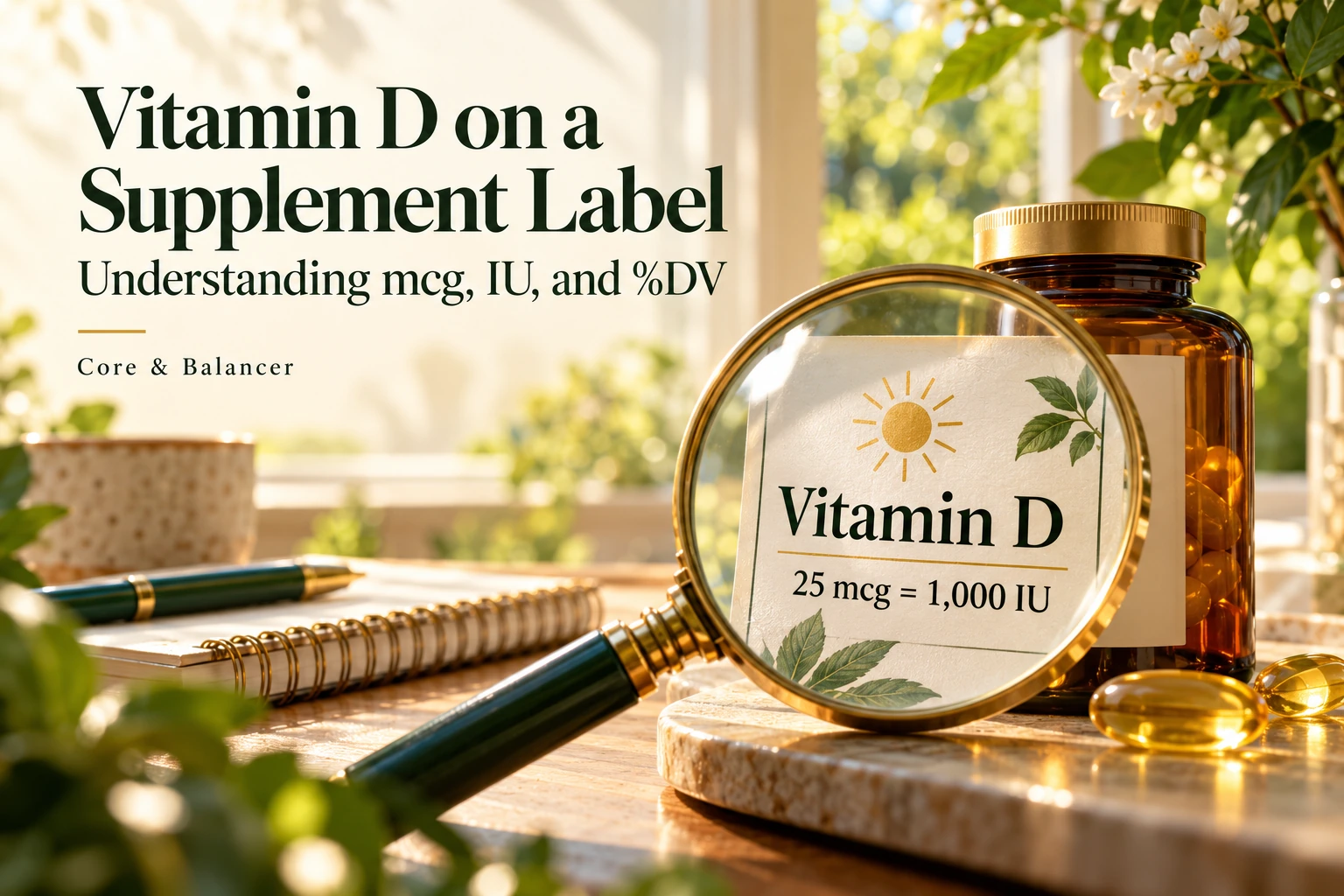
For vitamin D, 1 microgram (mcg) equals 40 International Units (IU). A label that says 25 mcg and one that says 1,000 IU may therefore describe the same vitamin D amount. The percentage beside the amount answers a different question: how that serving compares with the Daily Value used on the label.
Three numbers can look like three separate doses. Once you separate the unit conversion from the percentage calculation, the panel becomes much easier to read.
mcg and IU: two ways of expressing the amount
A microgram is a unit of mass. IU is a unit based on biological activity, with a conversion specific to the nutrient. NIH’s vitamin D fact sheet gives the relationship as 1 mcg = 40 IU. To convert vitamin D from mcg to IU, multiply by 40. To convert IU to mcg, divide by 40.
Worked example: 25 mcg × 40 = 1,000 IU. Going the other direction, 1,000 IU ÷ 40 = 25 mcg. The larger-looking IU number does not mean this is a different quantity.
Use this conversion for vitamin D only. Vitamins A and E have their own conversion rules; “multiply every vitamin by 40” will give you incorrect answers. The USDA and NIH unit-conversion resource distinguishes these nutrient-specific relationships.
What does %DV mean for vitamin D?
The FDA Daily Value for vitamin D is 20 mcg on general labels for adults and children age 4 and older. On that basis, 20 mcg is 100% DV. Other age or life-stage label categories can use different reference values, so check which population a label is intended for.
For the general 20 mcg reference, the calculation is: vitamin D amount in mcg ÷ 20 mcg × 100. For example, 25 ÷ 20 × 100 = 125% DV.
Three label-reading examples
- 10 mcg = 400 IU = 50% DV. This is half of the general 20 mcg Daily Value.
- 20 mcg = 800 IU = 100% DV. All three figures describe one amount against that reference.
- 25 mcg = 1,000 IU = 125% DV. The percentage is higher because the amount exceeds that reference.
These are arithmetic examples, not recommendations to take these amounts or statements about a particular Mother Earth Labs formula. They let you practice reading the numbers without making a product choice first.
Check “per serving” before comparing bottles
Suppose one hypothetical panel lists 20 mcg per two capsules, while another lists 20 mcg per one capsule. Their stated full servings contain the same vitamin D amount, but their capsule counts differ. Taking one capsule from each would not provide the same amount.
Put the serving size beside your conversion before comparing. Our guide to Supplement Facts per serving and per capsule explains how to keep those quantities aligned. For liquid comparisons, use the stated measured volume rather than assuming a dropper squeeze is one serving.
Why 100% DV is not a personal prescription
The Daily Value is a labeling reference. Your recommended intake depends on age and circumstances, and your clinician may have a plan based on an assessment. A %DV is neither a blood-test result nor a measure of how much you will absorb. It also does not tell you whether a higher amount is appropriate for you.
Write down the vitamin D supplied by every supplement you already use and bring those labels to your clinician or pharmacist. A multivitamin and a separate vitamin D product may both contribute to the same daily total. The daily multivitamin buying checklist helps place that review alongside the rest of a formula.
What if the mcg and IU numbers do not match?
Check that both numbers describe vitamin D, the same serving, and the same product version. Photograph the current panel and ask the manufacturer to clarify a mismatch before relying on either figure. Do not average two conflicting amounts or choose the one you prefer. Keep your comparison tied to the current container.
For a broader look at the contents behind the numbers, read our Comprehensive Core formula guide. This article explains units; the product’s current panel supplies its actual amounts.
Sources and scope
NIH: Vitamin D fact sheet · FDA: Daily Value on the Nutrition and Supplement Facts Labels · USDA/NIH: Unit Conversions. Reviewed October 26, 2026. Educational label-reading guidance, not an individualized dose recommendation.