

By Dr. Rich Prather, D.C. · Product and label review: October 25, 2026.
MEL Probiotics combines nine identified strains with prebiotic ingredients in a one-capsule routine labeled at 20 billion CFU. The reviewed bottle provides 30 daily servings. This guide explains the strain codes, the manufacturer’s through-expiration stability statement and the role of the prebiotic entries.
In this guide
Read the count’s timing as well as its size
Read the strain names and codes with the CFU count, then check the manufacturer’s timing and storage statement. MEL describes its count as maintained through expiration when stored as directed. Those details make the label useful when comparing a specific strain or formula with research.
Why would you take Probiotics Capsules?
The gut microbiome is the community of microorganisms living in the digestive tract. Its activities interact with digestion and normal immune processes. A probiotic supplies live microorganisms selected for a particular nutritional or health purpose. Someone may consider one while reviewing digestive comfort, a change in routine or a clinician-guided gut-health plan.
This formula brings Bifidobacterium and Lactobacillus strains together. Mother Earth Labs positions the blend for digestive balance and GI immune support. The useful next question is which goal you want to address and whether research on the identified strains is relevant to that goal. That makes the choice more specific than simply shopping for a large CFU number.
The prebiotic ingredients add another layer. Larch arabinogalactan and fructooligosaccharides are included alongside the live microorganisms. Prebiotics provide substrates that certain microorganisms can use. The capsule may suit someone who prefers a compact, shelf-stable format with an identified daily serving.
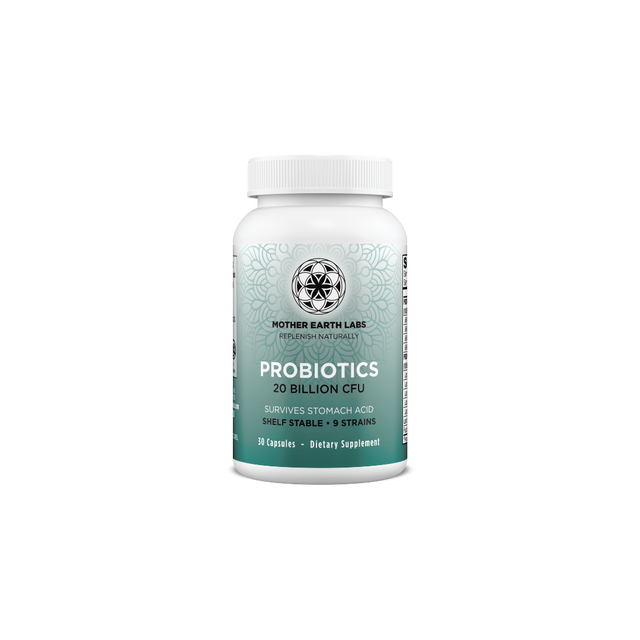
Affiliate DisclosureBuy Now — Probiotics Capsules. Affiliate Disclosure.
Current label at a glance
| Entry | Reviewed information |
|---|---|
| Serving / servings | 1 capsule / 30 |
| Total live-microorganism count | 20 billion CFU per labeled serving |
| Bifidobacterium group | 10 billion CFU in a 40 mg blend |
| Lactobacillus group | 10 billion CFU in a 51 mg blend |
| Larch arabinogalactan / FOS | 25 mg / 25 mg |
| Manufacturer stability statement | CFU through expiration when stored at room temperature as directed |
Source: official product information and posted manufacturer label. Confirm the current package when ordering or changing a routine.
Meet the nine labeled strains
The Bifidobacterium group lists B. lactis Bl-04, B. breve Bb-03, B. bifidum Bb-02 and B. longum Bl-05. The Lactobacillus group lists L. acidophilus La-14, L. rhamnosus Lr-32, L. plantarum Lp-115, L. salivarius Ls-33 and L. bulgaricus Lb-87. Record the strain code with the organism name when comparing research.
The letters and numbers distinguish a particular strain within a species. That matters because research findings depend on the organism, amount, formulation and outcome studied. A useful research question is whether a study tested the same identified strain for the same reason you are considering it.
What does 20 billion CFU mean?
CFU means colony-forming units, a way of expressing viable microorganisms capable of forming colonies under testing conditions. The panel gives 10 billion CFU for each of its two bacterial groups, totaling 20 billion per capsule. It does not divide that count equally among all nine strains.
Mother Earth Labs describes a stabilizing PolyMatrix process and a count maintained through expiration with proper room-temperature storage. Keep the current label and expiration date in view. Strain identity, appropriate use and storage help make the count meaningful.
Probiotics and prebiotics do different jobs
The probiotic portion supplies the live microorganisms. Larch arabinogalactan, listed as FiberAid, and FOS are the prebiotic ingredients. Each is listed at 25 mg. These small ingredient entries are useful for understanding the capsule, while vegetables, beans, whole grains and other fiber-containing foods help shape the wider dietary pattern.
If you are comparing this capsule with OrganiEarth or another product containing probiotics, review the organisms and the serving of each formula. A focused choice can be easier to evaluate than starting several overlapping gut products together.
A simple way to evaluate the routine
Before beginning, identify the digestive goal and keep a brief baseline of the pattern you want to follow, such as stool consistency or digestive comfort. Start with the selected product and an otherwise recognizable routine. A dated note about the serving and response can make a follow-up conversation more useful.
If considering a probiotic around antibiotic use, ask your pharmacist or clinician whether these strains fit the situation and how to schedule them with the medicine. People who are severely ill or have weakened immune systems should select probiotics with their healthcare team. These steps give the product a defined place in care.
Directions and storage that support consistency
The reviewed label directs adults to take one capsule daily during meals or as directed by a healthcare professional. A 30-capsule bottle therefore provides 30 labeled daily servings. Linking the capsule with the same meal can help keep the routine easy to remember.
Store it in a cool, dry place away from direct sunlight, as the label states. Keep the container closed and out of children’s reach. Shelf stable means the manufacturer specifies suitable room-temperature storage; it still matters to protect the bottle from a hot car, damp cupboard or direct sun.
Questions readers ask
Why take this probiotic? It is designed to support digestive balance through a blend of identified live microorganisms, with prebiotic ingredients included in a daily capsule.
Is a higher CFU count always the best choice? Choose around the strains, intended goal, relevant research and directions. The number is one part of that review.
Does this replace dietary fiber? The capsule includes small prebiotic entries. Continue building the wider food pattern with suitable fiber-containing foods.
Does it need a refrigerator? The reviewed label specifies room-temperature stability and cool, dry storage away from sunlight. Follow the directions on the bottle you receive.
Related guides
Match a probiotic strain code to a study
Explore GI UltraMAX as a different digestive formula
Explore nutrient terms in our Nutrient Dictionary.
Sources and further reading
Mother Earth Labs: current product information and directions
Manufacturer label or package image
NIH: probiotic strain identity, CFU and safety context
Educational nutrition information. Individual needs vary. Supplements are not intended to diagnose, treat, cure or prevent disease.