
What would you like to know?
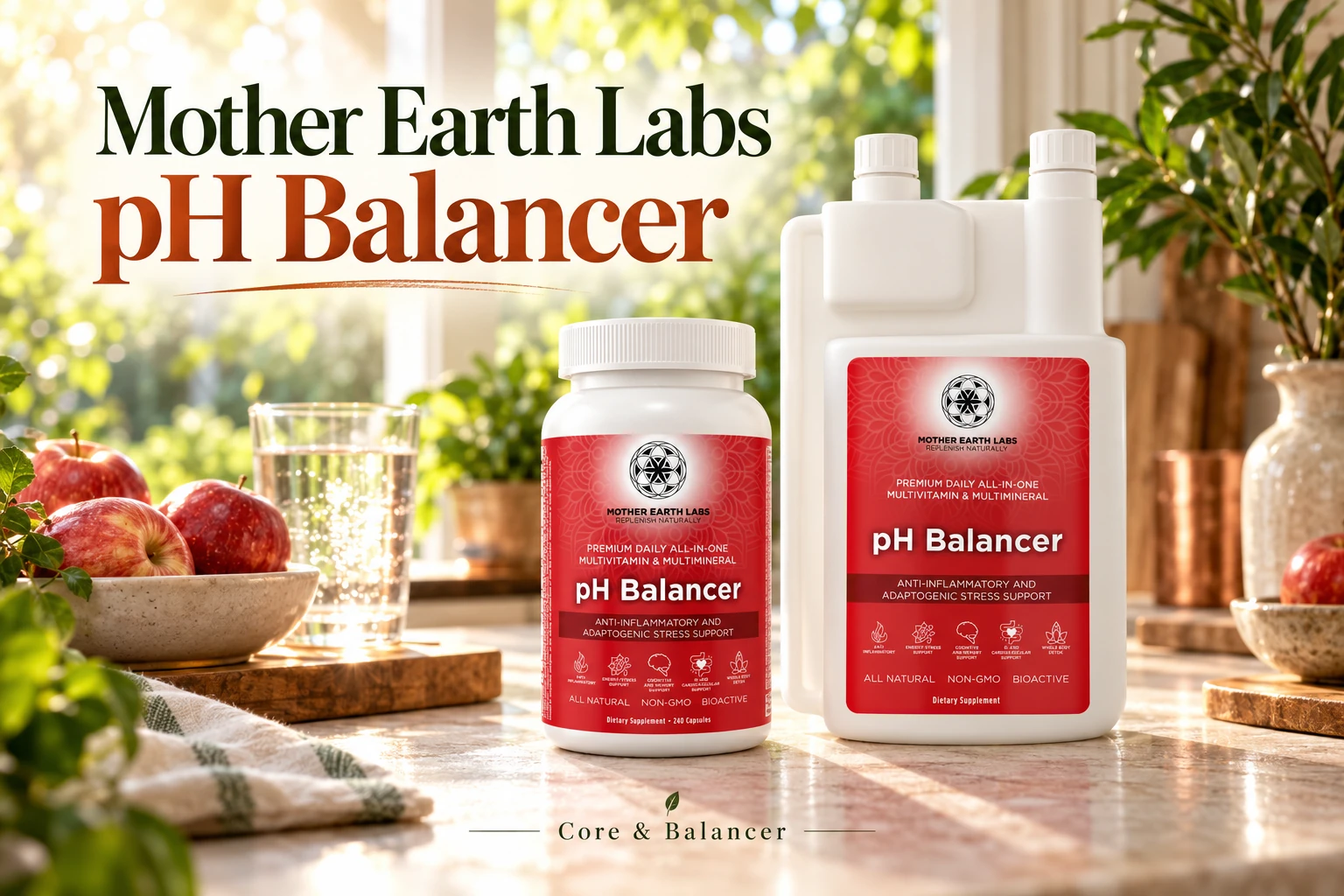
pH Balancer is a multivitamin and mineral formula, with additional plant ingredients, available as liquid or capsules. The first choice is practical: eight capsules make a full capsule serving; the liquid serving is one fluid ounce. Then compare the formulas below, because changing format also changes some ingredient amounts.
Start with the decision you actually need to make
If swallowing eight capsules sounds difficult, look at the liquid before studying every ingredient. If refrigeration and measuring would make daily use awkward, examine the capsules. Once the format fits, compare the nutrient amounts and botanical blend with what you already take. The product name does not establish a change in blood pH.
By Dr. Rich Prather, D.C. · Editorial review: October 23, 2026. Product panels reviewed October 22; official prices and product listings rechecked October 23, 2026.
Mother Earth Labs pH Balancer combines a multivitamin and mineral base with a substantial list of herbs and other plant ingredients. Its distinctive feature is that wider formula, especially the separately named stress-and-brain blend. Understanding its ingredients makes it easier to appreciate what each format offers and how it fits your routine.
Start with the ingredients you are interested in learning about alongside your vitamins. Then compare the format: eight capsules or one fluid ounce of liquid. The sections below explain which amounts change, what remains undisclosed and how the bottle choices affect cost and storage.
A useful label detail: both reviewed formats list 125 mcg (5,000 IU) vitamin D3 per full serving. Read the intake and interaction considerations when planning how it fits with your existing routine.
Choose the exact format below. The gallon pump is sold separately.
Capsules — a counted daily serving

8 capsules make a full serving. The 240-capsule bottle provides 30 servings.
Affiliate DisclosureBuy Now — CapsulesLiquid — a measured daily serving

One fluid ounce makes a full serving. Start with a quart for a 32-serving bottle, or compare the 128-serving gallon below.
Buy Now — Liquid Dispensing QuartpH Balancer is the product’s name. The lungs and kidneys regulate the body’s acid–base balance; MedlinePlus explains this normal physiology. MedlinePlus on acid–base balance
pH Balancer capsules vs liquid: how do the formulas compare?
The clearest difference is the amount in a full serving: liquid lists 300 mg each of calcium and magnesium, while eight capsules list 200 mg each. Both list 200 mcg methylcobalamin B12. The liquid and capsules also have different tyrosine, citrulline and botanical disclosures. Use the separate columns in the complete table rather than assuming that eight capsules duplicate one ounce of liquid.
Compare the official capsule panel with the official liquid panel.
| Decision | Capsules | Liquid |
|---|---|---|
| Daily routine | 8 capsules | Measure 1 fl oz; shake and refrigerate |
| Travel and convenience | No liquid measuring; substantial pill count | Useful if swallowing several capsules is difficult; requires cold storage after opening |
| Formula comparison | Use capsule amounts and named forms | Use liquid amounts and named forms |
| Bottle choices | 240 capsules / 30 servings | Gallon 128 servings; each quart 32 servings |
Use the capsule count to judge convenience, and the nutrient columns to judge composition. Switching formats does not preserve every ingredient amount. That gives you two useful ways to choose: the routine you prefer and the ingredient profile that matches your priorities.
pH Balancer ingredients: vitamins, minerals and the full formula
Read the main nutrient table first. It shows the amounts in one complete serving of each format. The expandable sections then list the remaining blend ingredients and enzyme activities. A blend’s total weight is shared among its ingredients; it does not give you a separate dose for each one.
| Ingredient / nutrient | Liquid: per 1 fl oz | Capsules: per 8 |
|---|---|---|
| Vitamin A | 900 mcg RAE; retinyl palmitate and CaroCare beta-carotene | 900 mcg; CaroCare beta-carotene (panel omits RAE) |
| Vitamin D3 | 125 mcg (5,000 IU); cholecalciferol | 125 mcg (5,000 IU); VegD3 vegan cholecalciferol |
| Vitamin E | 15 mg; SunVit | 15 mg; SunVit |
| Vitamin K2 | 60 mcg; Mena-Q7 | 60 mcg; Mena-Q7 |
| B1 (thiamine) | 20 mg; BenfoPure benfotiamine | 20 mg; BenfoPure benfotiamine |
| B2 (riboflavin) | 12 mg; riboflavin 5′-phosphate | 12 mg; riboflavin 5′-phosphate |
| B3 (niacin) | 125 mg NE; niacinamide | 125 mg NE; niacinamide |
| B5 | 20 mg; Pantesin pantethine | 20 mg; Pantesin pantethine |
| B6 | 14.5 mg; pyridoxal 5′-phosphate | 14.5 mg; pyridoxal 5′-phosphate |
| Folate | 680 mcg DFE; L-5-MTHF calcium | 680 mcg DFE; L-5-MTHF calcium |
| B12 | 200 mcg; methylcobalamin | 200 mcg; methylcobalamin |
| Biotin | 300 mcg | 300 mcg |
| Betaine | 100 mg | 100 mg |
| Vitamin C | 300 mg; ascorbic acid with fruit polyphenols and bioflavonoids | 300 mg; ascorbic acid with fruit polyphenols and bioflavonoids |
| Calcium | 300 mg; Albion calcium chelates | 200 mg; calcium ascorbate and citrate |
| Magnesium | 300 mg; Albion amino acid chelate | 200 mg; magnesium malate and ascorbate |
| Zinc | 30 mg; Albion TRAACS zinc chelate | 30 mg; zinc ascorbate |
| Selenium | 55 mcg; L-selenomethionine | 55 mcg; L-selenomethionine |
| Copper | 450 mcg; Albion TRAACS copper chelate | 450 mcg; copper bisglycinate chelate |
| Manganese | 1.2 mg; Albion TRAACS manganese chelate | 1.15 mg; Albion TRAACS manganese chelate |
| Chromium | 100 mcg; Albion TRAACS chromium chelate | 100 mcg; Albion TRAACS chromium chelate |
| Molybdenum | 45 mcg; Albion TRAACS molybdenum chelate | 50 mcg; Albion TRAACS molybdenum chelate |
| Boron | 1 mg; BorOrganic | 1 mg; Albion BorOrganic |
| Iodine | 88 mcg; dulse sea algae and potassium iodide | 90 mcg; organic dulse algae extract and potassium iodide |
| MSM | 100 mg; OptiMSM | 100 mg; OptiMSM |
| Trans-resveratrol | 10 mg | 10 mg |
| N-acetyl-L-tyrosine | 100 mg | 50 mg |
| CoQ10 | 50 mg; MicroActive CoQ10 | 50 mg; ubiquinone |
| L-citrulline | 50 mg | 100 mg |
| Quercetin | 50 mg | 50 mg |
| Rutin | 15 mg | 15 mg |
| N-acetylcysteine (NAC) | 100 mg | 100 mg |
| Curcumin / turmeric extract | 100 mg | 100 mg; 95% turmeric extract |
| Organic fenugreek | Not separately declared | 50 mg |
| Humic and fulvic substances | In GI blend; amount undisclosed | 40 mg combined |
Complete liquid ingredients, blend components and supporting ingredients
Amounts are per 1 fl oz (2 tablespoons). Blend totals are combined weights, not the dose of each member. A component appearing in more than one label section is not automatically an additional dose.
| Label grouping | Declared amount | All named components |
|---|---|---|
| Mixed carotenoids | 90 mg | Organic carrot, broccoli and kale |
| Vitamin C accompanying fruit complex | 100 mg | Organic acerola, camu camu, amla, orange peel, lemon peel, strawberry, mango and rose hips |
| Citrus bioflavonoid complex | 50 mg | Organic oranges, lemons and tangerines |
| Vitamin C accompanying polyphenols | Individual amounts undisclosed | organic grape, blueberry, cranberry, blackberry, raspberry and strawberry extracts |
| Organic fruits nutrition blend | Total and individual amounts undisclosed | Organic blueberry, pomegranate, acai, cranberry, strawberry, blackberry, raspberry, cherry, elderberry, noni, mangosteen, apple, pear, red grape, bilberry extract, orange, tangerine, lemon peel, acerola, camu camu, rose hips, amla, orange peel, mango and banana |
| Organic alkalizing greens and detox blend | Total and individual amounts undisclosed | Organic milk thistle, organic dandelion extract, curcumin/turmeric, organic spirulina algae, organic chlorella algae, organic moringa, organic globe artichoke, horsetail extract, organic olive leaf extract, organic astragalus, organic Atlantic kelp, organic carrot root, organic cabbage, organic broccoli and organic kale |
| Energy, stress and brain health support blend | Total and individual amounts undisclosed | Organic vitamin C complex, organic astragalus, organic bacopa monnieri, L-theanine, organic ashwagandha extract, organic green tea extract, organic Panax ginseng, organic rhodiola rosea extract, organic eleuthero root extract and organic holy basil extract |
| Cardiovascular and circulatory support blend | Total and most individual amounts undisclosed | Organic resveratrol extract, organic pomegranate, organic blueberry, organic acai berry extract, organic olive leaf extract, organic beet root, grape seed extract, CoQ10, L-citrulline, magnesium malate, organic green tea extract, organic garlic extract and organic hawthorn berry extract. Separately declared CoQ10, citrulline and resveratrol amounts appear above; do not add them a second time. |
| GI health, integrity, digestive enzymatic and prebiotic fiber blend | Total and individual masses undisclosed | BioCore complete digestive enzymes (activities below), bromelain from pineapple, papain from green papaya, organic digestion-resistant prebiotic fiber, L-glutamine, humic and fulvic extracts, and ginger extract |
| Essential amino acid blend | Total and individual amounts undisclosed | L-valine, L-tryptophan, L-threonine, L-histidine, L-isoleucine, L-leucine, L-lysine, L-methionine and L-phenylalanine |
| Essential fatty acids and phospholipids | Total and individual amounts undisclosed | Flax seed ALA omega-3 fatty acids and sunflower lecithin |
Digestive enzyme activities
| Enzyme activity | Per full labeled serving |
|---|---|
| Protease 1 | 5,250 HUT |
| Protease 2 | 12.5 SAPU |
| Protease 3 | 0.5 AP |
| Amylase | 1,750 DU |
| Lipase | 250 FIP |
| Glucoamylase | 2.5 AGU |
| Invertase | 200 SU |
| Diastase | 750 DP |
Activity units describe the enzyme’s measured action and cannot be converted directly to milligrams. Bromelain and papain are named separately from these activities.
Other ingredients
Purified water; organic apple, organic pear, organic red grape juice concentrate, organic elderberry, organic blueberry, organic blackberry, organic cherry and organic cranberry juice concentrates; organic flavors; organic pomegranate juice concentrate; stevia leaf; organic vegetable glycerin USP; organic acids; natural preservatives.
Liquid macronutrients per serving: 50 calories, total fat less than 1 g, total carbohydrate 9 g, dietary fiber 4 g, total sugars 2 g, protein 3 g.
Complete capsule ingredients, blend components and supporting ingredients
Amounts are per eight capsules. Blend totals are combined weights, not the dose of each member. A component appearing in more than one label section is not automatically an additional dose.
| Label grouping | Declared amount | All named components |
|---|---|---|
| Vitamin C accompanying fruit complex | 90 mg total | Organic acerola, camu camu, orange peel, mango and rose hips |
| Citrus bioflavonoid complex | 50 mg | Organic oranges, lemons and tangerines |
| Vitamin C accompanying polyphenols | Individual amounts undisclosed | organic grape, blueberry, cranberry, blackberry, raspberry and strawberry extracts |
| Organic fruits nutrition blend | 460 mg total; individual amounts undisclosed | Organic pomegranate, organic blueberry, organic BerryShield elderberry concentrate, organic bilberry extract (5:1), organic acai, organic cranberry, organic blackberry, organic noni extract, organic mangosteen, organic maqui, organic strawberry and organic raspberry |
| Organic alkalizing greens and detox blend | 275 mg total; individual amounts undisclosed | Organic milk thistle extract, organic spirulina algae, organic chlorella algae, organic globe artichoke extract, organic dandelion extract, organic moringa and organic kelp |
| Energy, stress and brain health support blend | 900 mg total; individual amounts undisclosed | Ashwagandha extract, L-theanine, astragalus extract, organic bacopa monnieri, rhodiola rosea extract, holy basil extract, eleuthero root extract and Panax ginseng |
| Cardiovascular and circulatory support blend | 360 mg total; individual amounts undisclosed | Organic beet root, pomegranate extract, organic olive leaf extract, hawthorn berry extract and grape seed extract |
| Digestive enzyme complex | 50 mg total | BioCore Optimum complete digestive enzymes (activities below) |
| Bromelain | 25 mg | From pineapple |
| Papain | 25 mg | From green papaya |
| Essential amino acid blend | 100 mg total; individual amounts undisclosed | L-valine, L-tryptophan, L-threonine, L-histidine, L-isoleucine, L-leucine, L-lysine, L-methionine and L-phenylalanine |
| Essential fatty acids and phospholipids | 100 mg total; individual amounts undisclosed | Flax seed ALA omega-3 fatty acids and sunflower lecithin |
Digestive enzyme activities
| Enzyme activity | Per full labeled serving |
|---|---|
| Protease 1 | 5,250 HUT |
| Protease 2 | 12.5 SAPU |
| Protease 3 | 0.5 AP |
| Amylase | 1,750 DU |
| Lipase | 250 FIP |
| Glucoamylase | 2.5 AGU |
| Invertase | 200 SU |
| Diastase | 750 DP |
Activity units describe the enzyme’s measured action and cannot be converted directly to milligrams. Bromelain and papain are named separately from these activities.
Other ingredients
The label states “DR Capsules.” It does not identify the shell polymer or every capsule-material detail; obtain that specification from MEL if it affects your choice.
For calories, sugars, carbohydrate, fiber or protein details beyond the photographed capsule panel, ask Mother Earth Labs for its current nutrition information.
How do the ingredient details help you compare?
Vitamins have specific nutritional jobs: B12 helps with nerve function and red blood cell formation; magnesium participates in normal muscle and nerve function; vitamin D supports calcium absorption. Those roles explain why the nutrients matter. They do not show that taking more will produce a noticeable benefit when intake is already adequate. NIH: vitamin B12; NIH: magnesium; NIH: vitamin D.
Ingredient forms help identify the formula. Methylcobalamin is a B12 form, L-5-MTHF is a folate form, and a chelate describes how a mineral is bound. Terms such as active and chelated do not, on their own, establish a better result for the complete supplement. Keep the named form and the amount together when comparing labels.
The botanical blend brings several ingredients together. The capsule stress-and-brain blend totals 900 mg across its ingredients, but their individual doses are not disclosed. Dividing the total by the number of ingredients would assume equal proportions that the label does not state. The liquid does not provide a corresponding blend total.
The linked research uses specific extracts and dosing schedules: an ashwagandha trial and a bacopa trial. They are ingredient studies, not tests of this complete formula. To interpret the research accurately, keep the specific extract, dose and study conditions alongside the product’s disclosed blend information.
Blend names describe how the manufacturer groups ingredients. Headings such as alkalizing greens, detox and cardiovascular support identify the manufacturer’s formulation themes. The ingredient entries provide the detail behind them. For example, flax supplies the ALA type of omega-3; EPA and DHA are different forms, so compare each by its own declared amount.
If the botanical blend is part of the appeal, take time to read its full ingredient list alongside the vitamins and minerals. NIH’s multivitamin overview helps connect those label details with diet and individual needs.
How do you take the liquid?
MEL directs one fluid ounce daily, followed by eight ounces of pure water; it may be taken with food. Shake well before every use—settling is normal—and refrigerate after opening. The liquid serving is two tablespoons, not a dropperful or an unmarked capful. Use an appropriate marked measure.
The pH Balancer liquid label says to use within one year of manufacture or six months after opening, whichever comes first. Check the date on your actual bottle. The gallon is 128 labeled servings, so a one-person daily routine takes 128 days; a quart takes 32 days. Storage space and the remaining shelf life matter as much as the headline price.
How do you take the capsules?
The reviewed manufacturer panel defines a full daily serving as eight capsules with at least eight ounces of water. It permits splitting that serving and advises avoiding the energizing formula late in the day. Eight is the label’s full-serving reference, not a personal dosing recommendation from this guide.
Bottle sizes, servings and cost: which option fits your routine?
This is a dated price comparison, using MEL’s one-time prices checked October 23, 2026. It is not a current checkout quote. Cost per serving equals the listed bottle price divided by its labeled serving count; tax, delivery charges, discounts and subscriptions can change the amount you actually pay.
| Version | Full label serving / container | One-time price | Cost per labeled serving |
|---|---|---|---|
| Capsules | 8 capsules / 30 servings (240 capsules) | $70.00 | $2.33 |
| Gallon | 1 fl oz / 128 servings | $230.00 | $1.80 |
| Dispensing Quart | 1 fl oz / 32 servings | $70.00 | $2.19 |
| Glass Quart | 1 fl oz / 32 servings | $78.00 | $2.44 |
| Round Quart | 1 fl oz / 32 servings | $70.00 | $2.19 |
The gallon offers savings when its size fits your routine. Four $70 quarts supply 128 servings for $280. The dated gallon price is $230, or $238 with the separately sold $8 pump: $42 less than four quarts. If you use only 64 servings from that first gallon, however, the cost becomes about $3.72 per used serving rather than $1.86 per labeled serving.
At those prices, you need to use about 109 servings from the gallon plus pump to bring its cost per used serving below a fully used $70 quart. Check refrigerator space and the bottle’s remaining shelf life before buying four months of supply. Keep the same appropriate serving routine whichever bottle size you choose.
The separate pump may make a gallon easier to dispense. MEL describes its Plastic Gallon Jug Pump as compatible with its gallon jugs and dispensing one ounce per pump. Confirm that output with a marked measure; it is a dispensing claim, not a reason to skip checking your serving. The dated price comparison includes $8 for the pump, which is not assumed to come with the gallon.
The dispensing, glass and round quarts each contain 32 fluid ounces. The dispensing bottle adds a measuring chamber; the glass option costs more, and the round option needs a separate appropriate measure. Readable dispensing, round and gallon label panels show matching liquid composition per ounce. The official glass-quart panel is now verified: revision PB32B1023MEL is identical to the reviewed dispensing-quart panel.
What should you check before choosing it?
Each full labeled serving supplies 125 mcg (5,000 IU) vitamin D3. That exceeds the general U.S. adult upper intake level of 100 mcg (4,000 IU) daily from all sources. A clinician may recommend more for a specific reason, but this is a reason to review total intake before starting. NIH vitamin D reference.
Both formulas contain vitamin K2, which matters if you use warfarin. pH Balancer also contains ashwagandha; avoid it during pregnancy and breastfeeding, and discuss thyroid or autoimmune conditions and medication interactions with your clinician. Rare liver injury has been reported with ashwagandha products. NCCIH ashwagandha guidance; NIH vitamin K interactions.
pH Balancer lists 14.5 mg vitamin B6 per full serving. NIH reports an adult U.S. upper limit of 100 mg daily and an EFSA limit of 12 mg. Compare total intake rather than treating either limit as a goal. NIH vitamin B6 reference.
The labels advise consulting a healthcare provider before use, particularly if pregnant or nursing, taking medicines or other supplements, or managing known or suspected allergies. Keep out of reach of children. Bring the full ingredient list to that discussion. Liquid labels use broad terms such as flavors and natural preservatives without identifying every substance; ask MEL about a specific allergy rather than assuming those categories are allergen-free.
Questions about pH Balancer
What is Mother Earth Labs pH Balancer used for?
It combines vitamins and minerals with additional botanicals, including herbs used in stress-support formulations. Compare the liquid and capsule tables to explore the ingredient amounts and choose the format that suits your routine. Source and further detail in the ingredient table.
How many pH Balancer capsules make a serving?
The reviewed capsule label uses eight capsules for a full daily serving. A 240-capsule bottle therefore supplies 30 full servings. The label permits split doses; use the actual directions on the bottle you receive. Source and further detail.
Is the liquid serving one ounce or a dropperful?
The liquid serving is one fluid ounce, equal to two U.S. tablespoons. MEL directs users to follow it with eight ounces of water. Use a marked measure or the appropriate dispensing feature, shake before use and refrigerate after opening. Source and further detail.
Do pH Balancer capsules and liquid contain the same amounts?
They have their own formulas. For example, calcium and magnesium are each 200 mg per eight capsules and 300 mg per one-ounce liquid serving on the reviewed panels. The format comparison and complete ingredient tables make these differences easy to check. Source and further detail.
Which liquid bottle should I choose?
Choose the dispensing quart for an integrated measuring chamber, the round quart for a conventional bottle and separate measure, or glass if that container is your preference. Each quart contains 32 ounces. The gallon supplies 128 one-ounce servings and has the lowest checked cost per liquid serving, even when the separately sold pump is included. Source and further detail.
Does the glass quart have a verified matching formula?
Yes. The readable official Glass Quart panel, revision PB32B1023MEL, was verified October 23, 2026. It is identical to the official dispensing-quart panel and lists 32 one-ounce servings. The liquid ingredient amounts in this guide apply to that verified panel. Source and further detail.
For a closer look at the label layout and nutrient forms, read our pH Balancer ingredient and label-reading guide. To compare the two product families, see Comprehensive Core versus pH Balancer.
Explore the five pH Balancer versions
- Mother Earth Labs pH Balancer Capsules — capsule count and formula differences.
- Mother Earth Labs pH Balancer Gallon — bulk value, pump and refrigeration.
- Mother Earth Labs pH Balancer Dispensing Quart — measuring chamber and a monthly routine.
- Mother Earth Labs pH Balancer Glass Quart — glass handling and the price premium.
- Mother Earth Labs pH Balancer Round Quart — standard bottle and separate measuring.
For the other formula, read Mother Earth Labs Comprehensive Core. To compare the products, use Comprehensive Core versus pH Balancer. Browse the Shop for the full range.
Choose your pH Balancer format
Match the format, ingredient amounts and storage routine to your needs, and review the full label before ordering.
Capsules
Buy Now — CapsulesGallon · compare cost and storage
Buy Now — GallonBuy the PumpDispensing Quart
Buy Now — Dispensing QuartGlass Quart
Buy Now — Glass QuartRound Quart
Buy Now — Round QuartSources and verification notes
Official MEL product pages and their displayed label images, checked October 22, 2026:
- pH Balancer Capsules · manufacturer label image
- pH Balancer Gallon · manufacturer label image
- pH Balancer Dispensing Quart · manufacturer label image
- pH Balancer Glass Quart · manufacturer label image
- pH Balancer Round Quart · manufacturer label image
- Plastic Gallon Jug Pump — compatibility, one-ounce dispensing and separate price
Panels: PB240C1023MEL capsules; PB32B1023MEL liquid quarts; PB128B1023MEL gallon. The glass-quart panel was verified October 23, 2026; its image is identical to the dispensing-quart panel. The review date records the source check; consult your bottle for its manufacture date and current packaging information.
Look up nutrient names, forms and aliases in the health dictionary, or use the site’s Find Answers search. Dictionary product matches use the reviewed format-specific manufacturer labels.